Support the reporting behind tonight's coverage. The Marblehead Independent is free, independent and powered entirely by readers — 110 Marblehead neighbors already chip in, with a goal of 175 by July. Become a member to keep local journalism going, and if you haven't yet, sign up for our free weekly newsletter.
For the best experience, turn your phone horizontal.
Monday, May 4 · 7 p.m. · Marblehead High School Field House, 2 Humphrey St.
BY WILL DOWD
Marblehead Town Meeting wraps
In a single night at the Marblehead High School Field House, the 2026 Annual Town Meeting cleared all 40 warrant articles, sent a three-tier Proposition 2½ override to the June 9 ballot, adopted the 3A multifamily overlay on its fourth attempt and approved the $122.8 million FY27 operating budget. Scroll the live feed for the night as it unfolded; the tracker below shows the status of every article.
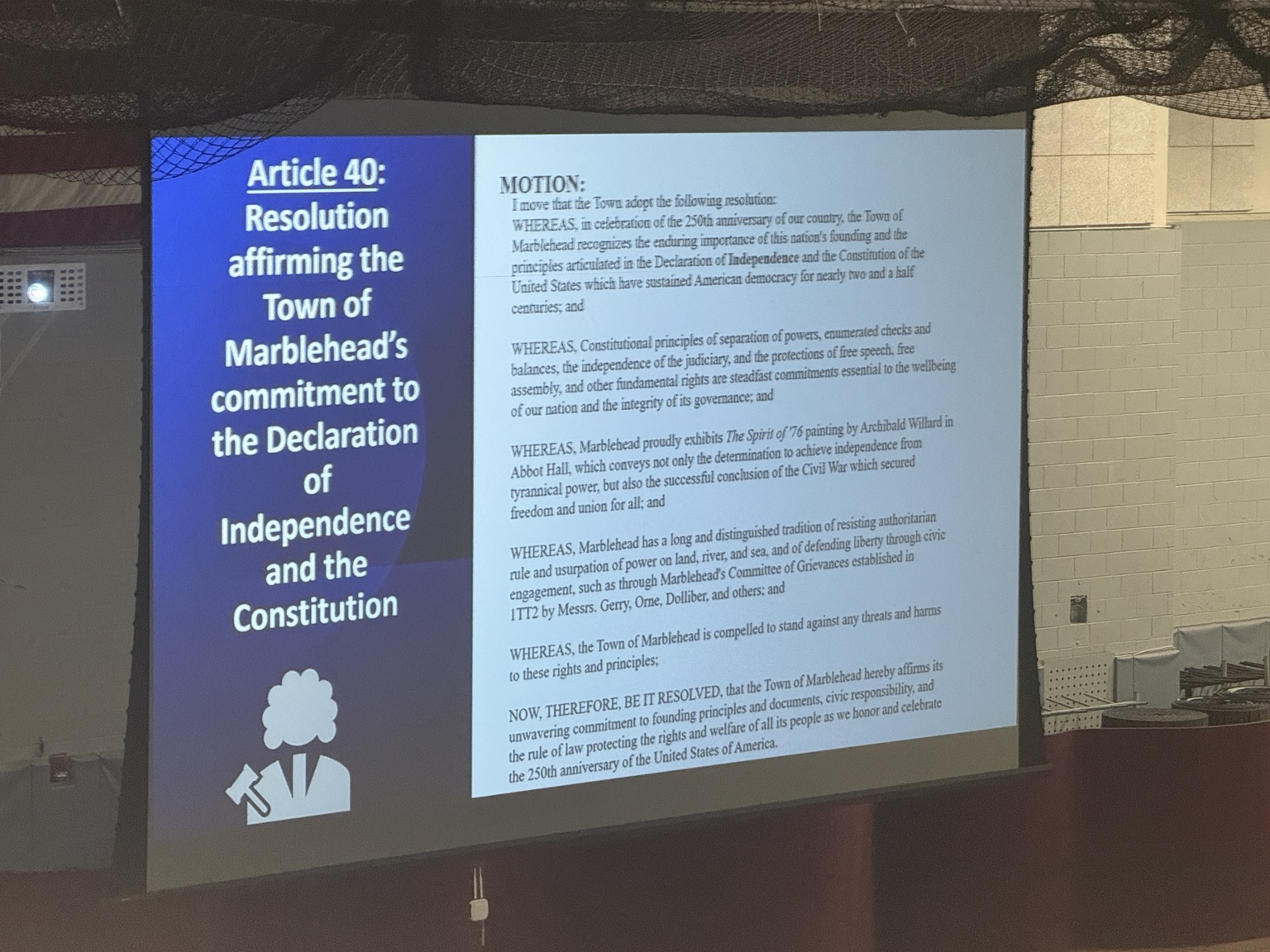
Lynn Nadeau took the floor in a Continental Army officer's blue coat and a tricorn hat, holding aloft a print of Archibald Willard's "The Spirit of '76" — the painting that hangs in Abbot Hall and is named explicitly in the article's whereas clauses. She presented Article 40, the non-binding resolution affirming Marblehead's commitment to the Declaration of Independence and the Constitution.Lynn Nadeau presents Article 40, the non-binding Constitution resolution, in Continental Army colors and holding "The Spirit of '76." Courtesy photo / Michelle BrownAn amendment offered by Walter Homan failed on the floor. The article itself passed.The Article 40 motion as projected at the front of the Field House. Will Dowd / The Marblehead IndependentWith the warrant cleared, Town Meeting voted to dissolve. The 2026 Annual Town Meeting wraps in a single night — a finish nobody on the floor expected at the 7 p.m. gavel.
10:37 p.m.
Article 37 passes; citizen petitions 38 and 39 indefinitely postponed
Article 37, a set of housekeeping bylaw amendments to the Department of Public Works sponsored by the Select Board, passed on a hand vote. The two citizen petitions that followed it both came off the warrant. Article 38, which would have shortened Select Board terms from three years to one, was indefinitely postponed. Article 39, which would have repealed the Department of Planning and Community Development created by Town Meeting in 2024, was indefinitely postponed; the Finance Committee had voted unfavorable. One article remains: Article 40, the non-binding Constitution resolution Lynn Nadeau and Kate Borten brought to the floor.
10:35 p.m.
Articles 34 and 36 disposed of; four to go
Article 34, the Select Board's proposal to dissolve the Public Works Committee outright, was indefinitely postponed after voters chose the modernize-the-committee path under Article 35 a moment earlier. Article 36, a cosmetic bylaw cleanup retiring the obsolete title "Surveyor of Highways" in favor of "Department of Public Works director," passed without dissent. Four articles to go: another set of DPW bylaw amendments, two citizen petitions on Select Board terms and on the Department of Planning and Community Development, and the non-binding resolution affirming the Constitution.
10:33 p.m.
Article 33 passes; six articles to go
Town Meeting banned cryptocurrency ATMs in Marblehead, passing Article 33 and joining a growing number of Massachusetts municipalities taking the same step. Existing machines — the police department believes there is one currently operating in town — must be removed within 60 days. Violations will carry a $300-per-day, per-device fine. Six articles to go on the warrant.
10:31 p.m.
A reporter's note: 13 Town Meetings in, a one-night first
I have been covering Marblehead Town Meeting since 2013. I have never seen one wrap in a single night.
Most years, the warrant runs to two or three sessions. Override years run longer. Even quiet warrants usually need two sessions, because somebody, somewhere, finds the microphone they have been waiting all year for and uses it. There is a kind of comfort in that. Town Meeting is supposed to be slow.
Tonight is different. The big questions came first by design — the 3A overlay, the FY27 budget, the Proposition 2½ override, the warrant's biggest dollar items. By 9:30, the room had cleared its biggest votes. By 10:30, with the compensation block and most of the routine capital articles in the book, the moderator was estimating the meeting could finish before midnight.
Some of it is the warrant — frontloaded by the For Marblehead amendment voters approved at the start of the night. Some of it is the moderator, who held a hard two-minute clock and pulled debates back to the question on the floor. Some of it is the Field House, which holds 1,200 voters more comfortably than any room in town has held a meeting in a long time.
But mostly it is the voters. They came to do the work. They did not come to talk about it.
— Will Dowd
10:28 p.m.
Articles 30 and 31 pass without dispute
Two more cleared the floor without resistance. Article 30, the housekeeping rescission of the $1,619,627 unspent on the Gerry/Brown school bond authorized at $54.8 million, passed; the project is complete and the leftover authorization is retired. Article 31, the modest enhancement to the non-union administrative benefits package — three personal days and a $750 longevity bump, costing roughly $12,000 in total — also passed.
10:27 p.m.
Articles 24 through 28 indefinitely postponed
Five articles in a row went off the warrant by indefinite postponement. Article 24, the General Stabilization Fund, had no transfer requested in either direction. Articles 25, 26 and 27 — the school buildings capital, school technology and general school capital placeholders — carried no FY27 requests from the School Committee. Article 28, the school supplemental override piece the School Committee had been considering, was indefinitely postponed because the school portion of the override is being handled inside Article 29, which Town Meeting already passed.
10:23 p.m.
Articles 15 through 21 pass
The compensation block moved without dissent. Articles 15, 16 and 17 set 3 percent cost-of-living increases for administrative employees, traffic supervisors and seasonal staff effective July 1, 2026. Article 18 set the town clerk's salary at $97,460. Article 19 ratified the three-year fire union contract at 3 percent / 3 percent / 3.5 percent. Article 20 ratified 38 personnel actions the Compensation Committee took in calendar 2025, including 10 reclassifications and three new positions replacing obsolete roles. Article 21, the $749,920 Essex North Shore Agricultural and Technical School assessment, also cleared.
10:10 p.m.
Articles 11 through 14 pass; Attridge floats finishing tonight
The pace held. Town Meeting passed Article 11, the $25,000 walls-and-fences appropriation (cut in half from the historical $50,000 line), and Article 12, the $200,000 stormwater construction appropriation (also cut in half, from $400,000). DPW had warned that both reductions barely cover regulatory minimums and could compound coastal-infrastructure pressure in future years. Article 13, the water and sewer consent bundle, passed at $4.5 million from retained earnings — $2.4 million for water-side capital work and $2.1 million on the sewer side. Article 14, the $3.5 million interest-free MWRA loan authorization for water-distribution work, cleared the required two-thirds.
Town Moderator Jack Attridge told the room he estimates roughly an hour's worth of warrant business remains, raising the prospect that the 2026 Annual Town Meeting could finish in a single night.
10:04 p.m.
Town Meeting clears Articles 5 through 10 in quick succession
After the override and the 3A vote, the room moved fast. Town Meeting cleared the next six articles in short order. Article 5, the Planning Board's ADU bylaw amendments bringing Marblehead's accessory dwelling unit rules into line with the new state ADU law, passed on the required two-thirds vote. Article 6, the annual nine-tenths supermajority appropriation for prior-year unpaid bills, passed at the revised $60,018.27 figure FinCom adopted at its April 27 hearing after a late $36.98 school invoice was added. Article 7, setting a $4,205,300 spending cap on the town's 13 revolving funds, passed. Articles 8 and 10 — the annual placeholders for departmental equipment and public buildings — were indefinitely postponed; no department submitted a request this year. Article 9, the $510,682 appropriation for the town's active lease-purchase agreements (police cruisers, DPW trucks, fire and rec vehicles, school bus leases), passed at the revised number FinCom approved on April 27 after a school bus lease adjustment trimmed about $13,000 off the original ask.
10:02 p.m.
On the floor: Article 5, ADU bylaw amendments
Article 5 is on the floor. The Planning Board's proposal updates Marblehead's accessory dwelling unit bylaw to conform with the state's new ADU law. Key changes: removing the bedroom cap on ADUs, lowering the short-term rental threshold from 90 to 31 days and adding Zoning Board of Appeals review for ADUs on nonconforming lots. The Finance Committee found no measurable financial implications and made no recommendation. Two-thirds vote required.
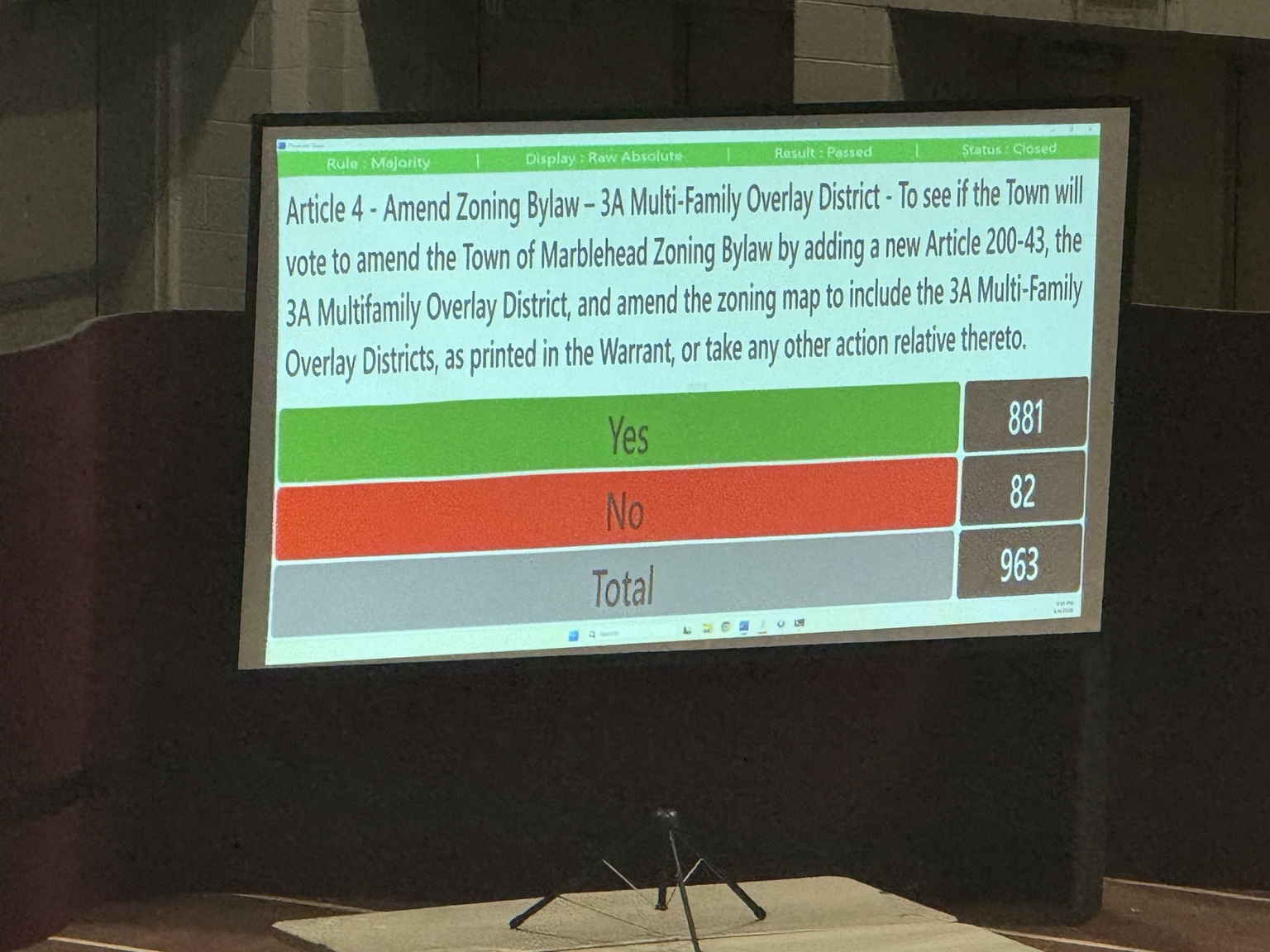
After three failed attempts in as many years, Town Meeting adopted Article 4 — the 3A multifamily overlay district — on a lopsided 881-82 electronic vote, with 963 ballots cast. About 91 percent of voters in the room said yes. Marblehead now has compliant zoning under M.G.L. c. 40A § 3A, with two overlay subdistricts on Broughton Road and at Tedesco Country Club where multifamily housing will be allowed by right. The vote ends a multi-year standoff with the attorney general's office, which had sued the town in January and held the case pending tonight's vote, and clears the way for Marblehead to compete again for state grant programs the town has been shut out of, including MassWorks and Housing Choice. Turnout was down from the 1,386 ballots cast on Article 29 about 25 minutes earlier — the mass exit after the override vote registered on the tally board.The Article 4 vote, projected at the front of the Field House. Will Dowd / The Marblehead Independent
9:55 p.m.
From the floor: Tedesco, taxes and the lawyer bill if 3A fails
The Article 4 debate ran along three threads. The first was Tedesco. A voter asked whether Tedesco Country Club had agreed to be inside the overlay. The presenters said the club's leadership had been briefed and its questions answered, but stressed that 3A is a zoning overlay, not a mandate to build. "If Tedesco decides they never want to sell it, then nothing will ever change," one presenter said. The same point was made about Broughton Road: the overlay simply allows multifamily by right; it does not require any new construction.
Affordability drew the second round of questions. Under 3A, presenters said, towns may require up to 10 percent of new units in an overlay district to be affordable. That is the cap, not the floor — the statute leaves it to each community to decide how aggressively to pursue affordable housing within the overlay. The Planning Board has chosen to take the full 10 percent. Affordable-housing advocates from the floor pressed for more; presenters said anything beyond 10 percent would have to come through a separate process, not through tonight's article.
The third thread was money. A voter asked whether the Tedesco property would be reassessed at higher value under the new zoning. The answer, from the presenters: no, because the country club's land is classified as Chapter land — the state preferential-assessment program for open space and recreational use — and a zoning change does not by itself trigger a new assessment. The land would only be reassessed if it were sold and redeveloped. Another voter asked whether the town could recover the roughly $4 million in MassWorks, Housing Choice and other state grants Marblehead has been shut out of. Presenters said the closed application cycles cannot be recouped, but compliance makes the town eligible for the next rounds.
Nick Ward, speaking in support, framed the choice in plain terms. The 3A question lost on a town-wide ballot last year by five points, he said, "which tells me we need a five-point swing to get housing reform done in this town. Five points seems gettable to me." He said he did not want to be back at Town Meeting in three years choosing between library hours and another property-tax increase.
Another speaker put the cost of saying no in lawyer terms. "We adopt this now," he said, "or we go into debt paying lawyers so that the state can tell us how we're going to adopt it later, in a way that might be less beneficial." Presenters confirmed that if Town Meeting rejected Article 4, the attorney general would lift the stay on the January lawsuit and resume action.
9:53 p.m.
Context: how Marblehead got to its fourth 3A vote
Section 3A is the 2021 Massachusetts statute — M.G.L. c. 40A § 3A — requiring the 177 cities and towns served by the MBTA to designate at least one zoning district near transit where multifamily housing is allowed by right. The minimum number of units a community must zone for varies by category. Marblehead, classified as an MBTA-adjacent community, has a relatively modest target but has not yet adopted compliant zoning.
Tonight is the town's fourth attempt in three years. Earlier proposals failed at Town Meeting or were withdrawn after pushback over neighborhood impact, density and which sites should carry the burden. The Massachusetts Supreme Judicial Court settled the underlying legal question in 2024 in Attorney General v. Town of Milton, ruling that 3A is enforceable and that Milton's noncompliance was unlawful. Following that decision, the attorney general's office has moved to enforce the statute against holdouts. Marblehead was sued in January and the case has been held in abeyance pending tonight's vote.
The cost of noncompliance has been concrete. Marblehead has been shut out of nearly $4 million in MassWorks, Housing Choice and related state grant programs over the past two funding cycles, and several state agencies condition discretionary awards on 3A status. Town officials have said the practical question tonight is no longer whether the town will comply but where the overlay districts will be drawn. Tonight's proposal — two subdistricts on Broughton Road and at Tedesco Country Club — is the Select Board's answer.
9:48 p.m.
On the floor: Article 4, the 3A multifamily overlay — debate underway
Article 4 is on the floor: the town's fourth attempt in three years to comply with the state's Section 3A multifamily zoning law. The proposal carves out two overlay subdistricts — one along Broughton Road, the other on the grounds of Tedesco Country Club — where multifamily housing would be allowed by right. The article is sponsored by the Select Board and recommended favorable by the Finance Committee. Vote threshold: simple majority.
The stakes outside the room: the state attorney general sued Marblehead in January over noncompliance and is holding the case pending tonight's vote. Noncompliance has shut the town out of nearly $4 million in MassWorks, Housing Choice and other state grant programs over the past two cycles. Debate is underway; we'll post the speakers and the result as they come.
9:36 p.m.
Article 3 passes
With the override headed to the ballot, the meeting returned to numerical order and took up Article 3, the consent-articles bundle. It passed: liability for state waterway work, leases of town-owned land and buildings, Select Board authority to enter contracts of more than three years up to 10, and grant authorizations for the Conservation Commission. No dollar amounts attached.
9:33 p.m.
After the override vote, a mass exit; Attridge asks the room to hold quorum
Within minutes of Article 29 clearing 1,227-159, a noticeable share of voters stood up, gathered coats and headed for the doors. Town Moderator Jack Attridge interrupted to remind the room that quorum is 300 and asked anyone who could to stay through the rest of the warrant. Town Meeting still has 36 articles to take up, including zoning, capital and citizen petitions.Voters head for the exits after the override clears Town Meeting. Will Dowd / The Marblehead Independent
9:30 p.m.
Town Meeting sends the override to the June 9 ballot, 1,227-159
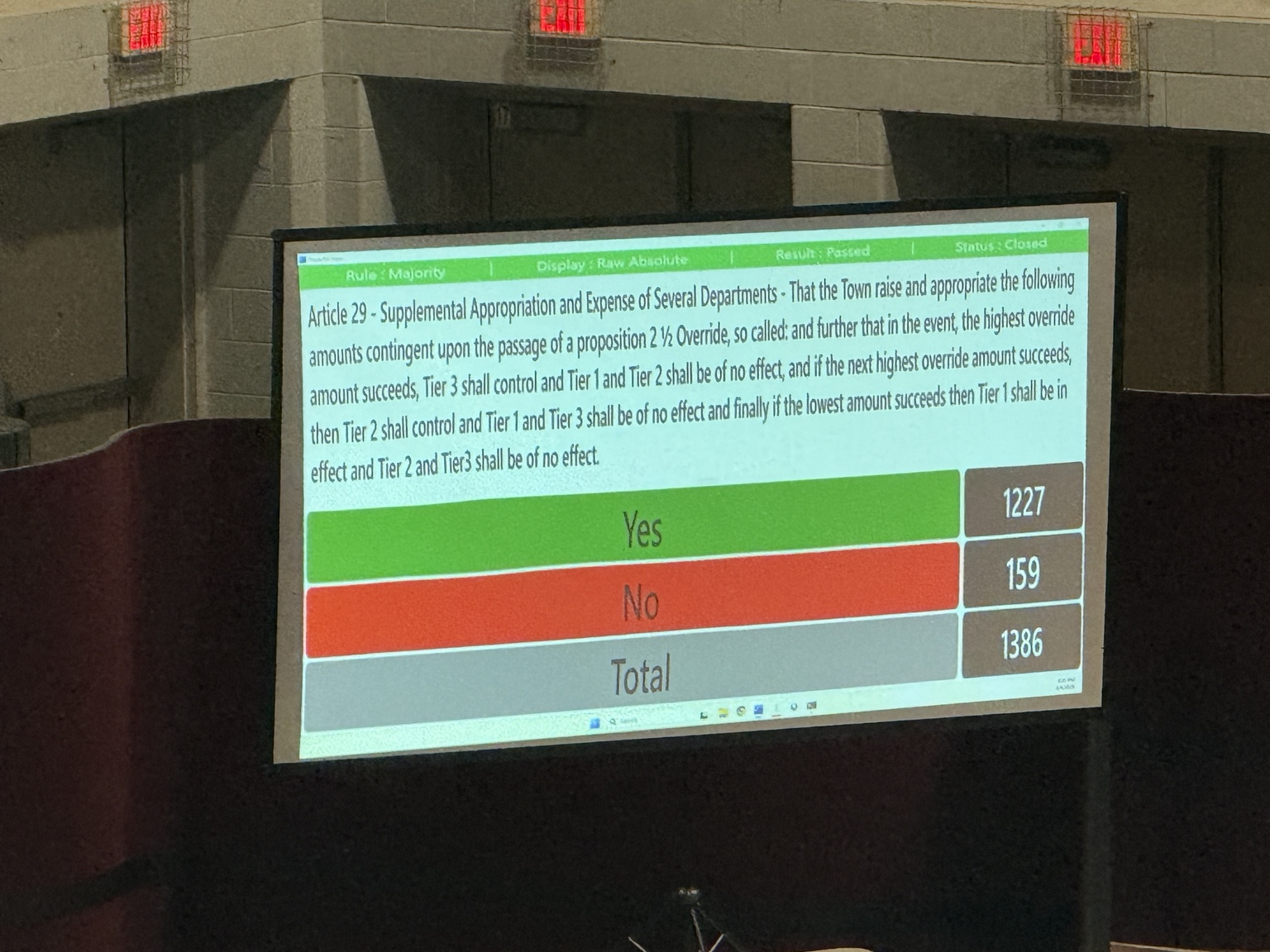
Article 29 passed in a landslide: 1,227 yes, 159 no, 1,386 ballots cast — about 89 percent of voters in favor. Marblehead voters will now decide the three-tier Proposition 2½ override at the ballot box on June 9, with separate yes-or-no questions for each tier. The highest tier to clear a majority is the one that takes effect; lower tiers are void if a higher tier prevails. If all three tiers fail at the ballot, Article 29 is void and the FY27 budget Town Meeting passed under Article 23 stands as is.The Article 29 vote, projected at the front of the Field House. Will Dowd / The Marblehead Independent
9:29 p.m.
Article 29 vote in progress
The clickers are out. Town Meeting is voting on Article 29 by electronic ballot. Result coming as soon as it's announced.
9:24 p.m.
Context: 44 years of Proposition 2½ votes in Marblehead
A note on what voters are weighing tonight. Since Massachusetts adopted Proposition 2½ in 1980, Marblehead voters have taken up 115 ballot questions tied to the law — and the pattern is remarkably consistent. Voters have approved 68 of 84 debt exclusions and 5 of 10 capital exclusions, but only 3 of 21 operating overrides. Operating overrides have been brought to the ballot since then and rejected; the last permanent general operating increase Marblehead voters approved was on June 15, 2005.
Marblehead Prop 2½ ballot history, 1982–2025
Debt exclusions (one-time borrowing for capital projects) clear the ballot more often than operating overrides, which permanently raise the levy. Source: The Marblehead Independent voter guide.
The distinction matters tonight. Article 29 is an operating override — a permanent increase to the property tax levy that funds recurring expenses like wages and benefits. Debt exclusions, by contrast, are one-time borrowing authorizations for specific capital projects (the school building bonds, the public library, the seawalls), and once the bonds are paid off the levy returns. Voters have historically been far more comfortable saying yes to bricks and mortar than to ongoing operating costs. The Select Board's three-tier override is, in part, an attempt to address that pattern by giving voters a more granular choice and a phased schedule.
9:08 p.m.
Fox opens the Select Board's case for Article 29 as hand-vote frustration boils over
Before Select Board Chair Dan Fox could begin his presentation on Article 29, another voter at the aisle microphone picked up the challenge James Full and John DiPiano had raised minutes earlier — sharper this time. The speaker accused Town Moderator Jack Attridge of choosing between hand votes and electronic ballots at his own discretion, asked why the town had distributed clickers at all if they would not be used on the night's most consequential questions, and noted he could not see tellers in the aisles ready to count hands. "Why the hell do we have these stupid clickers?" he said. "We're pushing overrides, we're pushing Prop 2½ — and we're going to go back to the hand count?"
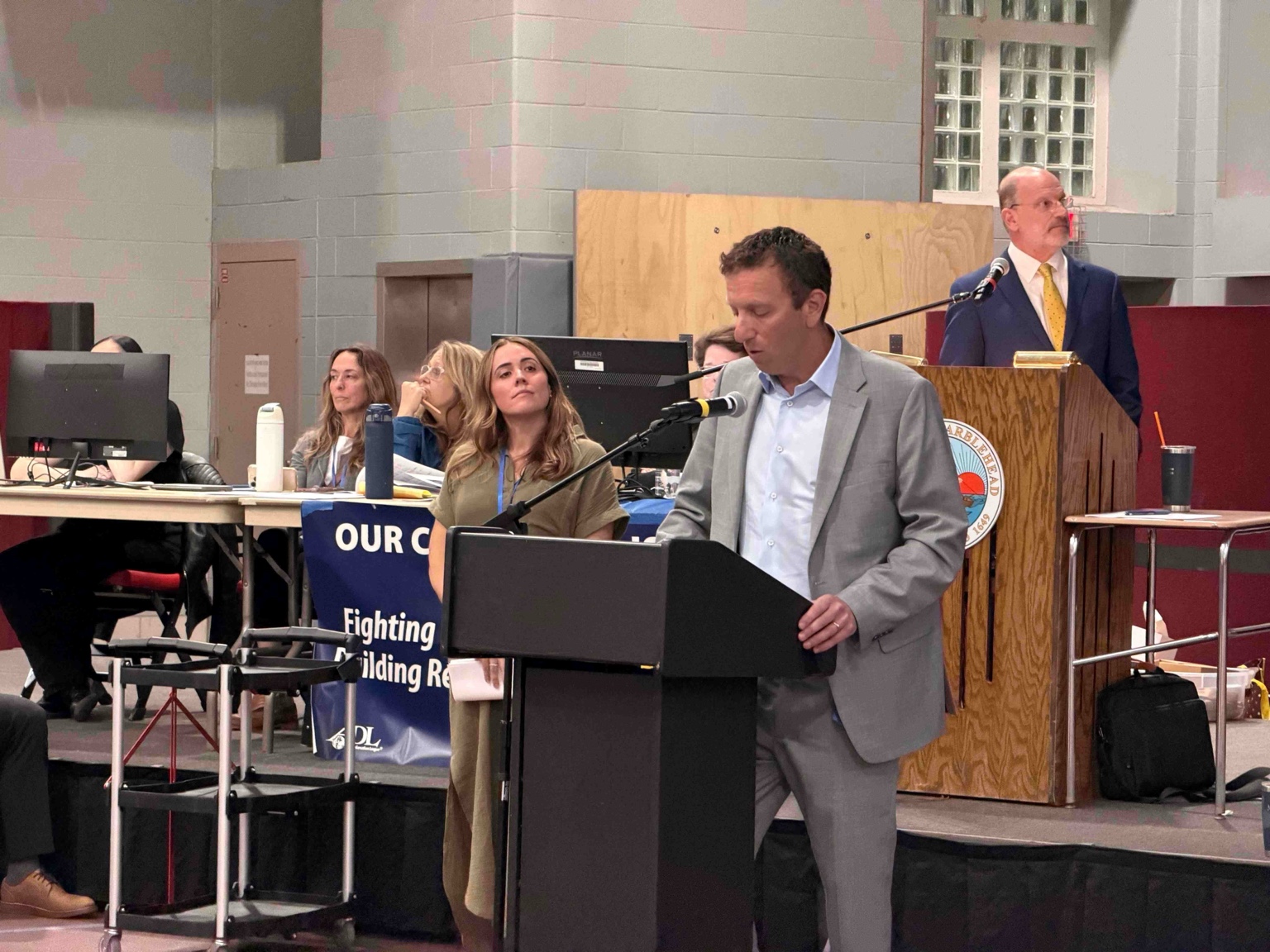
Fox then stepped to the lectern.Select Board Chair Dan Fox presents Article 29, with School Committee member Melissa Clucas standing to his left. Katie Ring / The Marblehead Independent"I'm Dan Fox, from the Select Board," he said, opening the board's case for Article 29. He confirmed the framing the Finance Committee laid out earlier: a $7.7 million FY27 budget gap, 43.5 positions eliminated across town departments and the schools, and a significant reduction in services the override package is designed to reverse. "This article is how we fund the restoration of positions, maintain quality municipal services and invest in improvements," Fox said.
Fox reminded voters that Article 29 is only step one. Even if Town Meeting authorizes the contingent appropriation tonight, the Proposition 2½ override only takes effect if voters separately approve it at the June ballot. "There are two steps to passing a Proposition 2½ general override," Fox said. "Tonight is one of them."
Why tonight matters. A yes on Article 29 puts the override on the June 9 ballot. Tonight's vote does not lock in any tier; it appropriates funding for the FY27 operating budget contingent on whatever tier voters ultimately choose. Curbside trash collection is on a separate ballot question on June 9; the Select Board is sending it to voters regardless of how Article 29 lands tonight, because Town Meeting already funded curbside collection inside Article 23 through the new household fee imposed by the Board of Health. If voters approve the trash override in June, that fee is replaced by general-fund money raised through the levy.
The case for action. Marblehead has not passed a general operating override since 2005, Fox said, while the Finance Committee has warned for years that recurring revenue is not keeping pace with recurring expenses. He pointed to a chart on the screen showing the gap widening: the blue line for available revenue and the red line for expenses cross in fiscal 2027 and diverge from there. Without an override, Fox said, the town faces another roughly $7.7 million deficit two budgets from now.
Three tiers, three years, one MOU. The Select Board's package gives voters three cumulative tiers to choose from. Tier 1, "partial restore," brings back some of the positions and services cut from the FY27 balanced budget but not all of them — on the town side, Fox said, Tier 1 returns 15 of the 20.5 full-time-equivalent positions eliminated. Tier 2 funds a fuller restoration of positions and services. Tier 3 reinvests in capital and adds positions and services cut in earlier budgets. Each tier builds on the one below it: anything checked into Tier 1 carries through into Tier 2 and Tier 3.
Each tier is implemented over three years, with the dollars phased rather than drawn down all at once. Tier 1 totals $9 million across three years — $1.3 million in year one, $5.3 million in year two and $2.4 million in year three. Tier 2's first-year draw is $2.8 million; Tier 3's first year is $4.3 million. The bulk of the funding lands in year two by design, Fox said, because that is when the school department is projected to face a $4 million budget cliff. The Select Board, the school committee and the Finance Committee signed a memorandum of understanding capping the override at those maximums and pledging not to return to voters for at least three years.
What Tier 1 buys. Fox walked the room through the line items inside Tier 1: enough library funding to retain the state accreditation waiver, though with reduced hours; the Council on Aging nutritional coordinator; the only two custodians at the Mary Alley building and Abbot Hall; the Police Department's school resource officer; a heavy-equipment operator and a laborer at DPW; and behind-the-scenes positions including a senior clerk in finance and the Community Development and Planning director. Fox then turned the lectern over to School Committee member Melissa Clucas to walk through what Tier 1 buys for the schools.
Tier 1 on the school side. The school side of Tier 1 looks different from the town side, Clucas said. Superintendent recommendations have not asked to restore any of the 18.25 full-time-equivalent positions cut from this year's school budget — enrollment has declined and staffing has been right-sized to that decline. Even with that adjustment, the schools project a $4 million operating deficit next year, on top of the 18.25 positions already eliminated. Tier 1 also returns to the general fund a set of positions that were moved into revolving funds to balance this year's budget; revolving funds cannot support those positions long term. To buy time, Clucas said, the schools are using $1.5 million in available funds this year to prepay FY27 out-of-district special-education tuition — the cost of placing students whose programs cannot be delivered in district. The prepayment is a one-time move that reduces this year's gap and spreads the override draws across two years rather than front-loading them.
Tier 2: stabilize and build. Fox returned to the lectern for Tier 2, which carries everything in Tier 1 forward and adds positions and services eliminated in earlier budget cycles. On the town side, Tier 2 funds a Council on Aging social worker, fully restores library staffing, brings back the GIS division at DPW, adds $450,000 in building maintenance, one police officer, two firefighters, a senior clerk in the town clerk's office, an IT director and a budget analyst in the finance department, plus an assistant planner and a conservation agent. On the school side, Tier 2 funds a $150,000-a-year classroom technology refresh starting in year two and, Fox said, full-day kindergarten for all families — pointing out that Marblehead is currently one of only a handful of Massachusetts communities that still charges families for full-day K.
Tier 3: invest and improve. Tier 3 builds on Tiers 1 and 2. Clucas walked through it. On the town side: one specialized heavy-equipment operator; one foreman; one additional police officer; two additional firefighters; one grant writer; $60,000 for community mental-health needs; and $1.5 million in recurring capital expenses across the town and school budgets. On the school side: $100,000 in professional development and an in-district special-education program for 18- to 22-year-olds who are entitled to educational programming and are currently being placed out of district.
What it looks like on a tax bill. Using the median assessed Marblehead home, Clucas walked the room through Tier 2 (the $12 million option) as the example: year-one increase of $280, year two of $676 and year three of $274. By year three, the median homeowner pays $1,230 more per year than today, on top of the standard 2.5 percent Proposition 2½ increase already built into the levy. Phasing the override draws across three years, rather than all at once, is intentional — the same logic that drives the year-by-year tier draws.
How the ballot works. The June 9 ballot will carry three separate questions, one for each tier, with advisory language reviewed by the secretary of state's elections division. Voters mark each question yes or no independently. Each question needs a majority. The tier with the highest dollar value that clears a majority is the one that takes effect — even if a smaller tier clears with more total yes votes. A Tier 1 voter votes yes on Question 1 and no on 2 and 3. A Tier 2 voter votes yes on 1 and 2 and no on 3. A Tier 3 voter votes yes on all three.
Fox's close. Fox returned to the central question: what happens if voters say no. A no on June 9, he said, means the cuts inside the FY27 balanced budget take effect — the library open three days a week, no school resource officer, higher overtime costs, 43.5 positions eliminated across town and schools. A no tonight, he added, means those cuts go into effect July 1. Beyond FY27, he said, a no leaves the schools with a projected $4 million deficit next year and a growing town-side deficit headed into the FY28 budget. "These are real people, real services that many of us depend on in this town," Fox said. "A yes vote tonight advances a solution to the ballot on June 9, where voters will decide which of these options they want. This vote is what's deciding what Marblehead we want, for us, for our children and for the future. I ask you to vote yes on Article 29."
8:59 p.m.
Full and DiPiano press the moderator: why hand votes instead of clickers tonight?
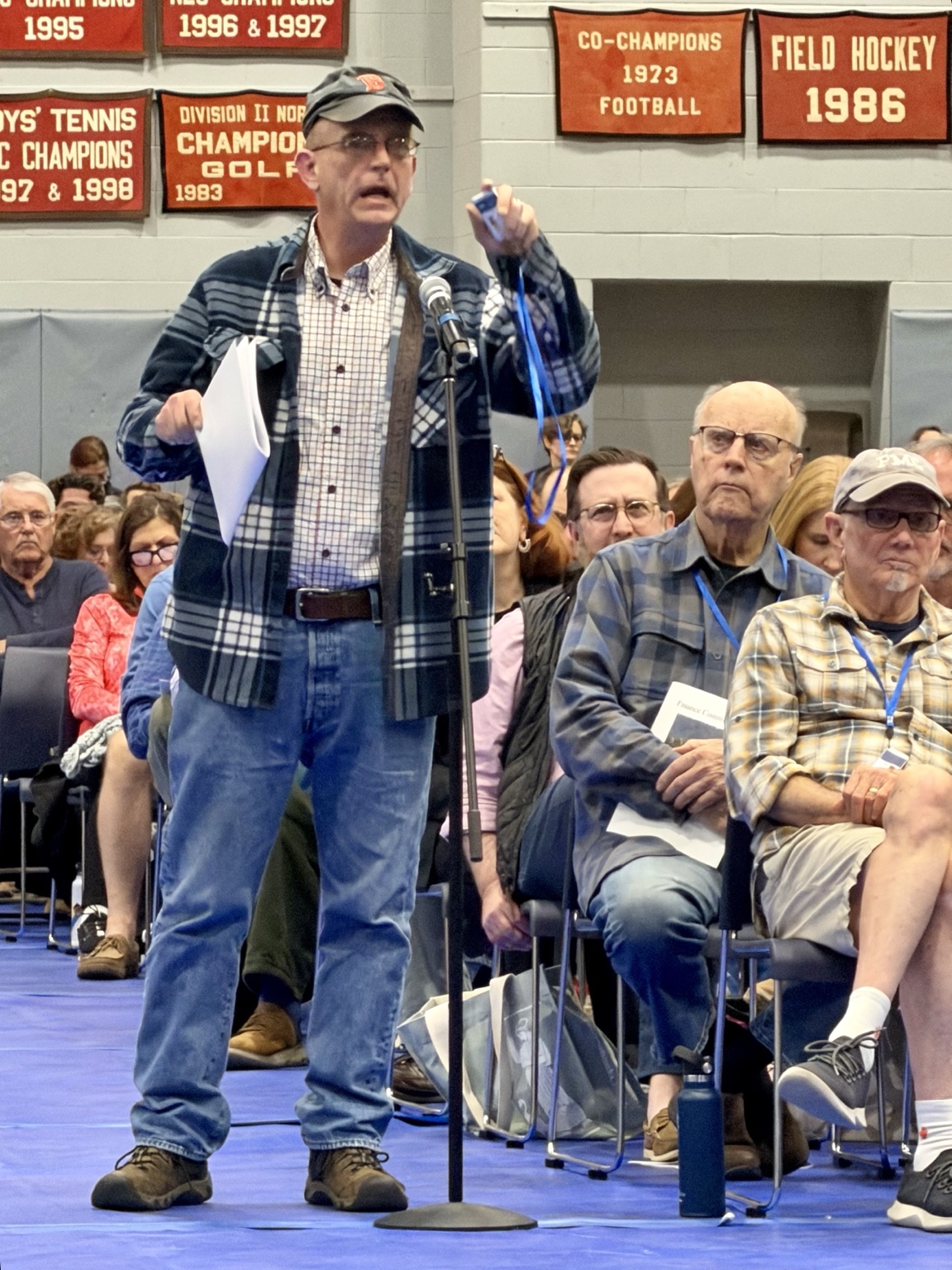
James Full and John DiPiano took turns at the aisle microphones to question why Town Moderator Jack Attridge has been calling so many votes by show of hands rather than by electronic clicker. Their argument: a public hand vote in a packed room invites social pressure on neighbors, and residents are more likely to vote their conscience in the privacy of a clicker. Both wanted to know why the moderator was leaning on hand votes for tonight's procedural and budget votes when every voter at the door was issued a Meridia ARS keypad capable of recording a secret ballot.James Full holds up his Town Meeting clicker as he asks the moderator why so many votes have been taken by show of hands. Courtesy photo / Michelle BrownAttridge has framed his approach in his ground rules: hand votes are reserved for routine business and indefinite postponements, with electronic voting saved for closer or more substantive questions. The challenge from Full and DiPiano is that what counts as "routine" tonight has included some of the year's most consequential line items.
8:53 p.m.
On the floor: Article 29, the tiered Proposition 2½ override
Town Meeting moved to Article 29, the central vehicle for the override package the Select Board has built around tonight's budget. The article asks voters to authorize a contingent FY27 appropriation — up to about $4.3 million in year one — that would only take effect if voters separately approve a Proposition 2½ override at the June ballot.
The override on the ballot is structured as three cumulative tiers: roughly $9 million, $12 million and $15 million across three years, with each tier marked yes or no by voters and the highest tier to clear a majority setting the permanent levy increase. Tier 1 ("restore") brings back positions cut from tonight's no-override balanced budget — including a firefighter position, a school resource officer, full library staffing and others. Tier 2 ("stabilize and build") adds building maintenance, additional public-safety and public-works staffing and salary-study recommendations. Tier 3 ("invest and improve") adds capital investments.
A separate $2.2 million override question on the same ballot would replace the new $262-per-household curbside trash fee with general-fund funding through the tax levy. The Finance Committee voted unanimously to recommend Article 29 and voted 7-2 to recommend the trash component. If voters reject the override at the ballot, Article 29 is void and tonight's no-override baseline stands.
Historical context cited in our reporting: since 1982, Marblehead voters have approved 68 of 84 debt exclusions but only three of 21 operating overrides. Operating overrides have been put before voters since 2005 and rejected; the last permanent general operating increase Marblehead voters approved was on June 15, 2005.
8:52 p.m.
Article 23 passes: Town Meeting adopts the $122.8 million FY27 budget
Town Meeting adopted Article 23, the fiscal 2027 operating budget — $122.8 million in total appropriations, $109.8 million of it raised through taxation. The vote sets the no-override baseline: this is the spending plan that takes effect if voters reject the override at the ballot box. Up next under the reordered warrant: Article 29, the tiered Proposition 2½ override.
8:46 p.m.
More holds on Article 23: trash, the grant coordinator and the library
As the moderator continued the line-by-line walk through Article 23, three more holds drew out substantive answers from town staff.
Trash: two lines, two purposes. Public Health Director Andrew Petty explained the difference between the budget's "waste collection" and "curbside collection" lines. Waste collection covers operations at the town's transfer station, including environmental monitoring. Curbside collection is the cost of picking up trash and recycling at the curb — the new five-year contract — plus processing and disposal of solid waste and recycling. One resident at the microphone said she did not want curbside funded by a separate household fee and would support an override to put it back on the tax rate.
Grant coordinator: cut and contested. Town Administrator Thatcher Kezer defended the elimination of the grant coordinator position in the Community Development and Planning Department. The position, Kezer said, does more than write grants — it coordinates reporting, time and regulatory requirements across every grant the town receives. Under the constraints of this year's budget, he said, the function will move into the finance department, with department heads and other key staff continuing to write and manage grants on top of their regular work. "Ideally, we would like to have that position back in order to be much more efficient," Kezer said. "But under the budget circumstances we were faced with, we had to make these tough choices."
The pushback came from Cindy Tower Lowe, who asked exactly how many grants the position has brought in. The Community Development and Planning director, on the floor with Kezer, said the department has secured roughly $1.9 million in grant funding since fiscal 2025, and noted nearly $4 million in 3A-related grants the town applied for and did not receive. "It's just another position that I think needs to be re-evaluated here, as opposed to chopping it up," Tower Lowe said.
Library: confirmed cut, with override caveat. A voter who held on the Abbot Public Library line asked whether the dollar figure on the floor reflects the cut Goolsby walked through earlier. The moderator confirmed it does. The library line tonight is the no-override baseline; if voters approve the override at the ballot box this spring, additional funding would flow back into the general fund and to the library. Tonight's vote, he stressed, is the budget that takes effect if the override fails.
8:39 p.m.
Buba presses Pifferling on the high school roof: "It's our savings"
The first real exchange of the night came over the roof. As the moderator worked the budget line by line, Marblehead resident Jack Buba called a hold on the school department line and turned to Michael Pifferling, the schools' assistant superintendent for finance and operations, with a pointed question: the high school roof project bid came in roughly $2 million below what Town Meeting had authorized; was the district planning to bank the savings or spend them?
Pifferling told Town Meeting the project is currently about $2.6 million under budget on the bid, but said the district has not yet factored in contingencies — rooftop fans that were not approved in the original budget, potential ceiling work and other items that surface once a contractor is on the roof. The intent, he said, is to come in as close to the bid number as possible, with contingencies handled inside the existing authorization.
Buba was not satisfied. He told the room he had been through this with the schools before, citing a past project he said started with about $15 million in extra room that "by the end, it was all gone." His frame: a savings on a public bid is not a contingency line, it is a return to the taxpayers who authorized the borrowing. "Just give us the 2 million back unless you really need it for something that you didn't see, not something that you want," Buba said. "For the record, the extra money between what we authorize based on your recommendations and what the bid is taking is not contingency. It's our savings."
The moderator pulled the back-and-forth back to procedure and asked the room to wait and see what the contingencies actually look like. The schools line stayed in place; no amendment was offered on the roof number tonight.
8:31 p.m.
Side note: a closer look at the Town Meeting clicker
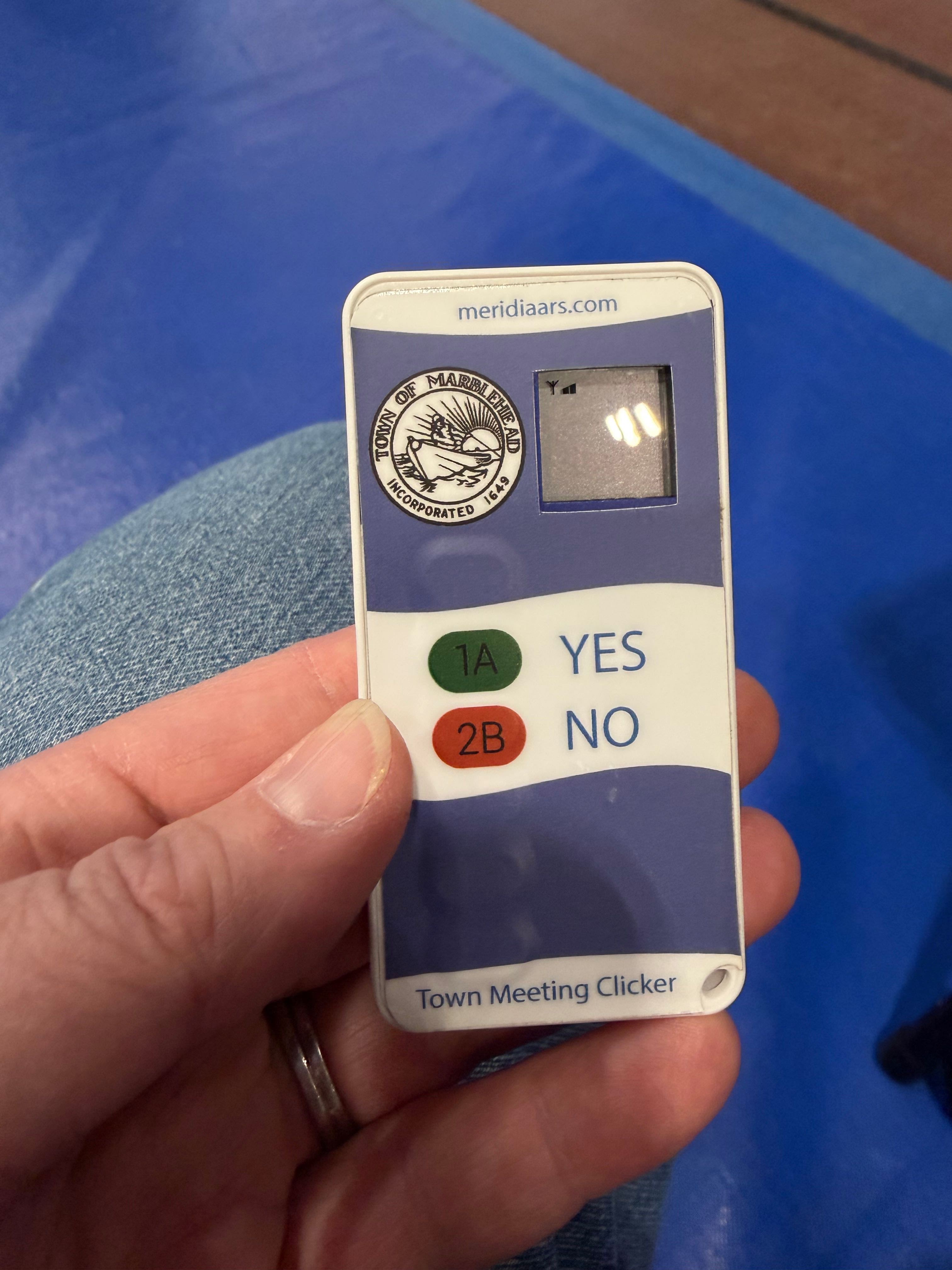
Every voter at the door tonight was handed one of these — a small Meridia ARS keypad branded with the Town of Marblehead seal and labeled "Town Meeting Clicker." Two buttons: a green "1A" for yes and a red "2B" for no. A tiny LCD across the top shows signal strength and battery so voters can see the device is talking back to the moderator's tally system. The town is in its third year of electronic voting; clicker tallies are projected on the front-of-room screen and become part of the public record of the meeting.The Town Meeting clicker. Green is yes, red is no. Will Dowd / The Marblehead Independent
8:16 p.m.
Benjamin on debt service: $26.2 million new issuance, AAA-with-negative-outlook, no new borrowing until 2032
Finance Director Aleesha Benjamin walked the assembly through Marblehead's debt service position under Article 23.
The ceiling. Town policy caps debt service at 15 percent of total general fund revenue, a ceiling that rises this year to roughly $15 million. The cap can be overridden only by a Select Board vote in the case of an emergency or a significant unforeseen circumstance that can be addressed only through borrowing.
Reductions on prior bonds. The Brown and Gerry school bonds, originally authorized at $54.8 million, came in at a final cost of $53.2 million — about $1.6 million under budget. Town Meeting will be asked to formally rescind that excess authorization in Article 30. The Massachusetts School Building Authority (MSBA) reimbursement on the same project exceeded the original estimate by $641,030, saving taxpayers roughly $42,735 a year through 2040. Bond premium and an earlier MSBA reimbursement reduce annual debt service by another $66,059.
The new issuance. Marblehead went to the market for $26.2 million and received a $1.5 million bond premium, bringing net borrowing to $25 million at a true interest cost of 3.75 percent — a number Benjamin attributed to the AAA-with-negative-outlook rating Standard & Poor's reaffirmed last month. Projects funded in this issuance include the Abbot Public Library (completed; $1 million borrowed to close out the project), sidewalk repair, town software, water and sewer improvements, the Mary Alley building improvements and the high school's roof and HVAC.
Net effect on the FY27 debt-service line. Total debt service drops from $11.5 million to $11 million, with most of the savings on the principal side.
The longer arc. Marblehead's total general fund debt outstanding, with the new additions, sits at $146.9 million stretched out to 2056. All debt that Town Meeting has authorized to date has now been borrowed in full, Benjamin said. The debt-service schedule drops by about $1 million in the 2030 to 2032 window and falls again sharply in 2035, when the bulk of the older bonds roll off and the line drops to roughly $8.5 million. The longest-tail items — running out to 2056 — are the Mary Alley building HVAC and ADA work and the high school roof-and-HVAC project. Benjamin's recommendation: no additional debt should be borrowed until 2032, when the next significant block of debt service falls off.
8:05 p.m.
Goolsby on Article 23: $7.7 million deficit, 22 town jobs cut, schools borrowing from next year
Finance Committee Chair Alec Goolsby walked Town Meeting through what he called the most challenging budget cycle in his nine years on the committee: a $7.7 million gap between the cost of running Marblehead at level service in fiscal 2027 and the revenue available to pay for it. "This has been the most challenging budget cycle in my nine years serving on this committee," Goolsby said.
Where the money is coming from. Total available revenue is forecast at $96.5 million, down $600,000 from FY26. The tax levy is up $2.1 million — the standard 2.5 percent allowed under Proposition 2½ plus an estimate of new growth. State aid is up about $200,000. Local receipts are down roughly $1 million, driven by lower interest income as rates and cash balances come off recent highs and a deliberately conservative motor vehicle excise estimate. Per state Department of Revenue guidance, the town budgets local receipts at about 90 percent of its best estimate of actual collections. Use of free cash to balance the operating budget is down $2 million from last year; certified free cash this spring came in lower than FY26 because of tighter prior-year budgeting, leaving the town no room to repeat last year's $1.5 million one-time bump that was used to delay an override.
Where the money is going. Level-service spending — the price tag of running the same departments at the same staffing as today — is $104.2 million: $27.9 million for town operating departments, $51.3 million for the schools and $25 million in shared employee benefits, the largest of which are health insurance and pensions. Subtract revenue from spending and you get the $7.7 million deficit.
What's driving the gap. Wages account for $3.1 million of the increase — about $1.3 million on the town side and $1.8 million on the school side, both reflecting collective bargaining agreements. Health insurance adds $1.7 million. The new five-year curbside collection contract adds $1 million. Pension contributions are up $500,000 on the schedule the Retirement Board has set to fully fund the town's pension liability by the state-imposed 2040 deadline. Out-of-district education tuition and transportation, which the town is legally obligated to provide for students whose needs cannot be met in district, adds $300,000. Smaller items add roughly $500,000. Combine $7.1 million in level-service expense growth with the $600,000 net revenue decline and you reach the $7.7 million deficit.
Health insurance: a slide of its own. Marblehead participates in the state Group Insurance Commission (GIC), the same plan used by the Commonwealth and many other Massachusetts municipalities. GIC premiums have risen sharply over the past five years, and the FY27 increase is roughly 10 percent across active employees and retirees combined — the equivalent of about $1.7 million in cost growth on Marblehead's books. In February, FinCom invited the town's insurance advisors to lay out the outlook; their conclusion, Goolsby said, was that the GIC remains the lowest-cost carrier that would cover the town and that any further reduction in the town's insurance bill would have to be negotiated through collective bargaining.
Health insurance spending and share of budget, FY02–FY27
Hover or tap a year for spending and budget share. Source: The Marblehead Independent voter guide.
A new way of splitting town and school costs. Goolsby spent extra time on what he called a "material improvement" to the budget process: a cost-accountability framework that reallocates shared benefits — health insurance, pensions and the like — to the side of the operation that actually employs the worker. Rerun under this lens, last year's town-school split moves from 49 percent town and 51 percent schools to 38 percent town and 62 percent schools. Applied to FY27, $4 million of the $7.7 million deficit is attributable to town departments and $3.7 million to the schools. FinCom expects town and school leadership to use the framework annually going forward.
How the town closed its $4 million. The biggest single item is a new annual fee for curbside waste and recycling, established by the Board of Health under the direction of the Select Board, projected to raise about $2.2 million. The collection costs remain in the operating budget but are now funded by the fee rather than the levy. A separate $2.2 million override question on the June ballot will give voters the choice to revert curbside back into the levy. On top of the fee revenue, departments absorbed roughly $2.4 million in cuts. The Abbot Public Library takes a $700,000 reduction including 8.25 full-time-equivalent positions, plus a $170,000 cut to its materials budget; Goolsby said the cuts will reduce the library's open days and put it at significant risk of state decertification, which would mean loss of state funding and the loss of borrowing privileges across the state. Other general government takes a $590,000 cut that includes the town's $250,000 annual contribution to its OPEB (other post-employment benefits) fund, its $250,000 contribution to the stabilization fund and $90,000 of its workers' compensation contribution — "short-term adjustments," Goolsby said, "at the expense of long-term financial stability." Community Development and Planning loses $300,000, including three of the department's five positions: department head, sustainability coordinator and grant coordinator. Smaller cuts run across DPW, finance, public buildings, the cemetery, the Council on Aging, the town clerk, police, building inspection, and recreation and parks. Eliminating filled positions also pushes unemployment costs up roughly $600,000, which means the town has to cut more than $4 million in payroll to net $4 million in savings. In total, the town side of the budget eliminates 22 full-time-equivalent positions — about 12 percent of the town workforce — of which 18 are currently filled and four are vacant. Without the new curbside fee, Goolsby said, the town would have been looking at cuts equivalent to roughly 25 percent of its workforce.
How the schools closed their $3.7 million. The single largest move is a one-time prepayment: $1.5 million of FY27 out-of-district tuition paid out of the FY26 budget, which lets the schools reduce their FY27 ask by the same amount. Goolsby said the maneuver protects classroom learning this year and eliminates the schools' need for an FY27 override request — but the $1.5 million returns to the FY28 budget, and combined with the wage step-ups in the new union contract sets up a significant FY28 cliff. The remaining school closure: $450,000 in salaries from vacant teaching and instructional-assistant positions, $350,000 in expenses shifted to revolving funds and grants (most of which will need to come back into the general fund in future years) and roughly $650,000 in further reductions across substitutes, supplies, curriculum, technology, administration and other operating lines.
FY27 operating budget at a glance
Hover or tap a slice or legend item to see the segment detail. Source: The Marblehead Independent voter guide.
School workforce. Goolsby said the school department's reductions eliminate 22 positions, about 4 percent of the school workforce: 11 vacant and 11 currently filled. The administration framed the cuts as continued right-sizing to current enrollment. Goolsby stressed that the positions eliminated this year will not be restored under any override scenario.
The year-over-year picture. Excluding debt service and enterprise funds, the FY27 balanced budget lands at $96.5 million, down 0.6 percent — about $600,000 — from FY26. Town operating budgets are down 3.9 percent year over year, a $1 million reduction; the school operating budget is down 3 percent, a $1.5 million reduction. Yet shared employee-benefit costs grew 8.4 percent, from $22.5 million to $24.4 million, a $1.9 million increase that swallowed the cuts on both sides of the operation.
Structural deficit and the bond outlook. Marblehead is running a recurring structural deficit, Goolsby said: recurring expenses — wages, health insurance, pensions, contracted services — have grown faster than recurring revenues for several years. The town has bridged that gap with the meals and rooms tax, targeted fee increases, expanded use of revolving funds, reliance on free cash and deferred capital investment. Those tools, he said, have run out. Bond-rating agencies are watching: on April 10, Standard & Poor's affirmed Marblehead's AAA general obligation rating but revised its outlook to negative, citing budgetary distress. Reserves stand at roughly 2 percent of the operating budget — about $2 million on the $96.5 million base — against the town's own 5-percent policy target, the equivalent of roughly $4.8 million.
The bottom line. The Finance Committee unanimously recommends a yes vote on Article 23 — $122.8 million in total appropriations for FY27, $109.8 million of it raised through taxation. Goolsby thanked the Select Board, the school committee, town department heads, municipal employees, town boards and committees, the residents who showed up at meeting after meeting through budget season, and his fellow Finance Committee members. Town Moderator Jack Attridge said voters will go through the budget by department line item; anyone with a question on a line can call "hold," the moderator will revisit any held items, and Town Meeting will then vote the budget by silos.
7:58 p.m.
Throwback: Drinker's tribute to Sean Casey, drafter of Marblehead's charter
Earlier tonight, during the Town Charter Committee's report under Article 2, Town Charter Committee Chair Amy Drinker paused to remember committee member Sean Casey, who died Dec. 4 at 68. Drinker called him the committee's "Thomas Jefferson" and said his meticulous footnotes and annotations on the draft language continue to guide the committee. Casey, a Marblehead native, came home in 2008 after 37 years as a regulatory consultant for federal agencies and stepped onto the Town Charter Committee — setting aside his own Marblehead History Project to draft the language that, as Drinker confirmed tonight, will go to the Select Board in June.Sean Casey, principal drafter of Marblehead's town charter, died Dec. 4 at 68. Courtesy photo / The Marblehead IndependentRead our obituary: Sean Casey, principal architect of Marblehead charter draft, dies at 68.
7:50 p.m.
Article 22 passes; on to Article 23, the FY27 operating budget
Article 22 passed, locking in the $5.4 million in free cash and electric surplus that will offset the FY27 property tax levy. Town Meeting moved straight to Article 23, the operating budget itself.
The Finance Committee is recommending $122.8 million in total appropriations for the fiscal year that begins July 1, 2026, with $109.8 million of that raised through taxation. This is the no-override baseline — the spending plan if voters reject the override package later this spring. Major line items inside the package: schools at $47.6 million (after absorbing 22 position cuts totaling $3.2 million in reductions), health insurance at $16.8 million, debt service at $11.1 million and a new $2.2 million curbside trash collection line. If the override fails, that trash line converts to roughly a $262 household fee administered by the Board of Health. Sponsor: Finance Director. Vote threshold: majority.
7:47 p.m.
Jumping the warrant: Article 22 takes the floor with $5.36M to reduce the tax rate
Per the reordered warrant, Town Meeting has skipped ahead to Article 22, which appropriates $5.4 million in non-tax revenue to offset the FY27 property tax levy. The package is $5 million from free cash — the audited surplus left after the prior fiscal year closes — and $360,000 from a surplus in the Marblehead Municipal Light Department. Finance Director Aleesha Benjamin is presenting.
The amount is down $2 million from the $7 million Town Meeting used last year, a reduction Town Administrator Thatcher Kezer has framed as a deliberate policy step away from leaning on free cash to balance the operating budget. Three and a half years ago, the town was using $10 million in free cash a year. After tonight's appropriation and a separate $288,000 for lease-purchase obligations, the town expects to leave roughly $700,000 to $1.2 million in free cash as an emergency cushion. The Finance Committee voted favorable. Majority vote.
7:46 p.m.
Article 2 passes on a hand vote
Article 2, the receiving of reports of town officers and committees, passed on a hand vote. Up next under the reordered warrant: Article 22, the available-funds tax-rate reduction.
7:43 p.m.
Armini: three of last year's warrant articles are now state law
State Rep. Jenny Armini, reporting from the General Court, told Town Meeting that three warrant articles approved at last year's annual session have since been signed into law as home rule petitions by Gov. Maura Healey. House Bill 4225 authorizes Marblehead to establish a means-tested senior citizen property tax exemption; a tax-relief forum on the new program is scheduled for Thursday, May 21, from 1 to 3 p.m. at the Community Center. House Bill 3912, signed Dec. 18, increases the membership of the Marblehead Board of Health from three to five members. Senate Bill 2528, signed Nov. 12, 2025, addresses parking fines during snowstorms. Armini thanked everyone who contributed to moving the petitions through Beacon Hill.
7:40 p.m.
Under Article 2, updates on school roof, transfer station and roadwork
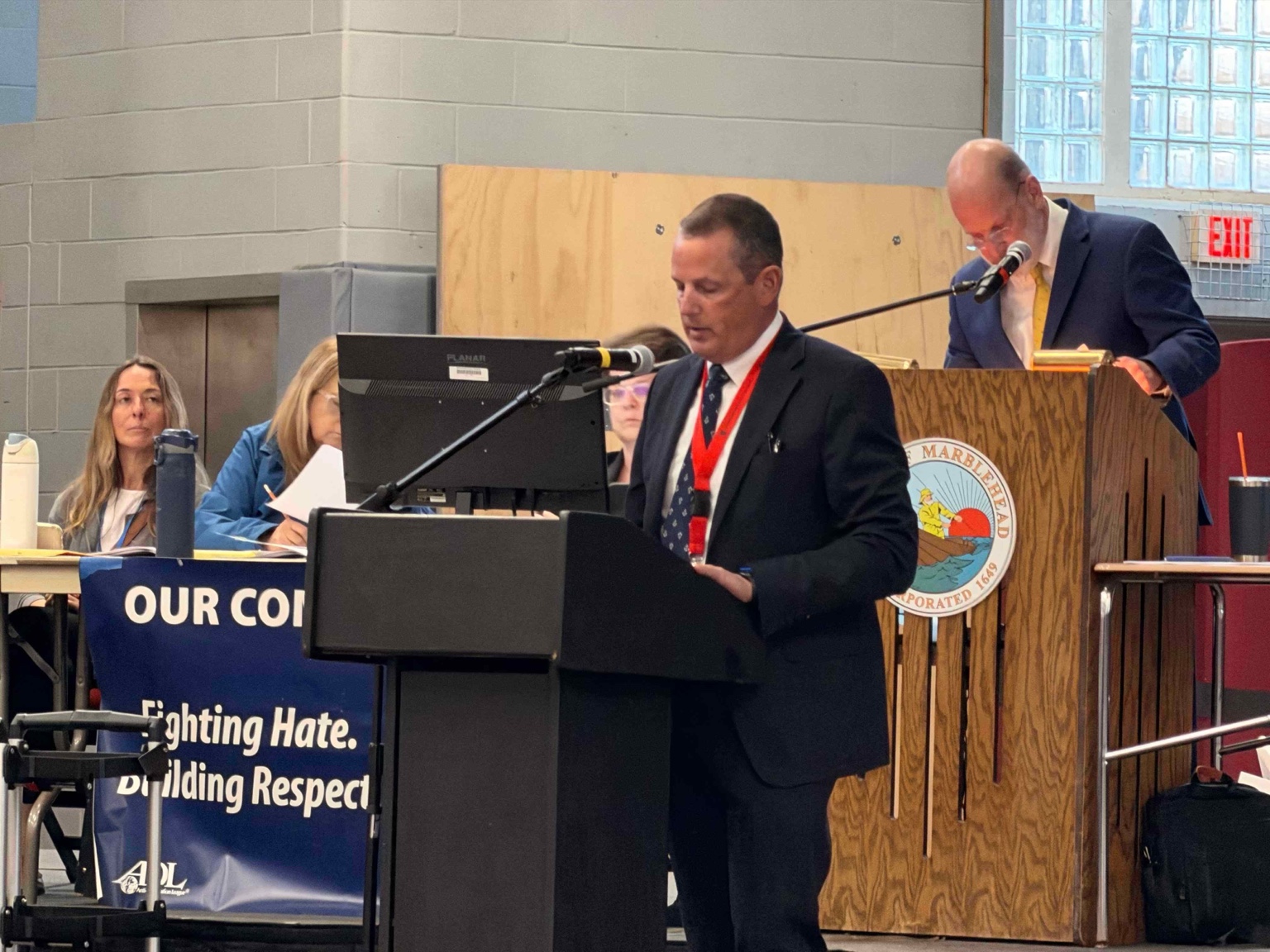
Michael Pifferling, assistant superintendent for finance and operations, on the high school roof project. Katie Ring / The Marblehead IndependentPublic Health Director Andrew Petty, on transfer station construction. Katie Ring / The Marblehead IndependentPublic Works Director Amy McHugh, on roads and sidewalks. Katie Ring / The Marblehead IndependentFinance Committee Chair Alec Goolsby, delivering FinCom's annual report. Katie Ring / The Marblehead Independent
Town Meeting moved into Article 2, the annual receiving of reports from town officers and committees. Town Moderator Jack Attridge has built in a practice of using the article to walk voters through outstanding capital projects already approved at past meetings. Three updates followed.
School roof. Michael Pifferling, assistant superintendent for finance and operations of the Marblehead Public Schools, said the high school roof project is on schedule and on budget. The general contractor, Homer Contracting, has begun work; the school committee selected a recover option over a full restore. Four small roof sections were replaced during April vacation. Major HVAC and main-roof construction begins June 23, the day after school dismisses, and is expected to wrap between August 30 and September 30. Through July and August, academic, athletic and other school programs will move to other school and town buildings.
Transfer station. Public Health Director Andrew Petty said the new scale house is complete, including the control room, break room and locker area, and the truck scale has been relocated to its permanent position in front of the compactor. Crews have installed a new concrete retaining wall, a pad for trash trailers and a steel wear wall, and finished curbing and grading. Pavement strengthening and gate installation are next. The redesign separates residential traffic from commercial weigh-and-pay flows. Still ahead: a new swap shed, a recycling area, the compactor building and a roll-up door. Petty also flagged statewide capacity pressures around construction and demolition disposal.
Roads and sidewalks. Public Works Director Amy McHugh said the department has shifted from pavement-only resurfacing to a "total streets" approach that coordinates water, sewer and gas work before any street is repaved. Town Meeting authorized $12,475,000 in 2022 for road and sidewalk network improvements; the resulting capital plan calls for $3 million a year for three years on top of state Chapter 90 funding. McHugh pointed to Commercial, West and Mystic streets as examples of the total-streets standard, and previewed major upcoming work on the Pleasant Street corridor and the Village Street bridge replacement, projects she said the town will pursue alongside aggressive state and federal grant applications.
Retirement Board. Retirement Board Chairman Robert "Bob" Peck announced the date of the board's annual public hearing on cost-of-living increases for town retirees: Wednesday, June 10, 2026, at 4 p.m., in the lower-level conference room of the Mary Alley building.
Town Charter Committee. Town Charter Committee Chair Amy Drinker said the committee, which has spent two years drafting charter-language amendments for town committees and department heads, will submit a summary memo and a draft charter to the Select Board in June. All committee documents are posted on the Town Charter Committee's tab on the town website. Drinker paused to remember committee member Sean Casey, who died in December of complications from cancer. She called him "a quintessential Header, both a shipyarder and a park rat," and said he had set aside his own Marblehead History Project two years ago to step onto the committee. He became the committee's "Thomas Jefferson," she said, drafting and meticulously revising the charter language; his footnotes and annotations still guide the work. She closed: "Sean Casey was a talented, very decent person. We miss him, and we thank him for his lifetime of service to our town. Huzzah."
Finance Committee. Finance Committee Chair Alec Goolsby delivered FinCom's annual report. The committee has a full roster of nine members, with Molly Teets and Pat Franklin serving as vice chairs. Goolsby singled out Teets at the close of his report, saying the time and effort she has put in over the past few years is "unprecedented." Goolsby said roughly 80 to 90 percent of the committee's year is spent reviewing and recommending the balanced budget that becomes Article 23, with public department-level liaison meetings running from November through March. Beyond the budget, FinCom this year produced a three-year forecast presented in December showing increasing deficits through fiscal 2029, an analysis of shared town and school benefit costs, a cost-accountability framework used to address the FY27 $7.7 million deficit and additional data analysis used by town leadership in shaping the Proposition 2½ override package on Article 29. The FY26 reserve fund, Goolsby said, stands at $444,000 tonight, with three approved requests totaling $129,000 and $315,000 remaining through June 30. The FY27 reserve has been cut by $30,000 to $414,000 to help close the operating gap. Reserve uses, he noted, require both Select Board and FinCom approval in separate public meetings.
7:26 p.m.
On the floor: Article 2, reports of town officers and committees
Town Meeting is receiving the annual reports of town officers and committees under Article 2, the second of the procedural openers. The article is acknowledged rather than appropriated; no action is required and no money is attached. Up next under the reordered warrant: Article 22, the available-funds tax-rate reduction.
7:25 p.m.
Town Meeting reorders the warrant; Article 1 passes as amended, 1,023-225
Voters adopted the For Marblehead amendment to reorder the warrant on a 1,055-250 electronic vote, then passed Article 1 as amended, 1,023-225. After the procedural openers, Town Meeting will take Article 2, then jump to Article 22, Article 23 and Article 29 — the available-funds tax-rate reduction, the FY27 operating budget and the tiered Proposition 2½ override — before returning to Article 3 and proceeding in numerical order from there.
7:17 p.m.
For Marblehead moves to take the budget and override first
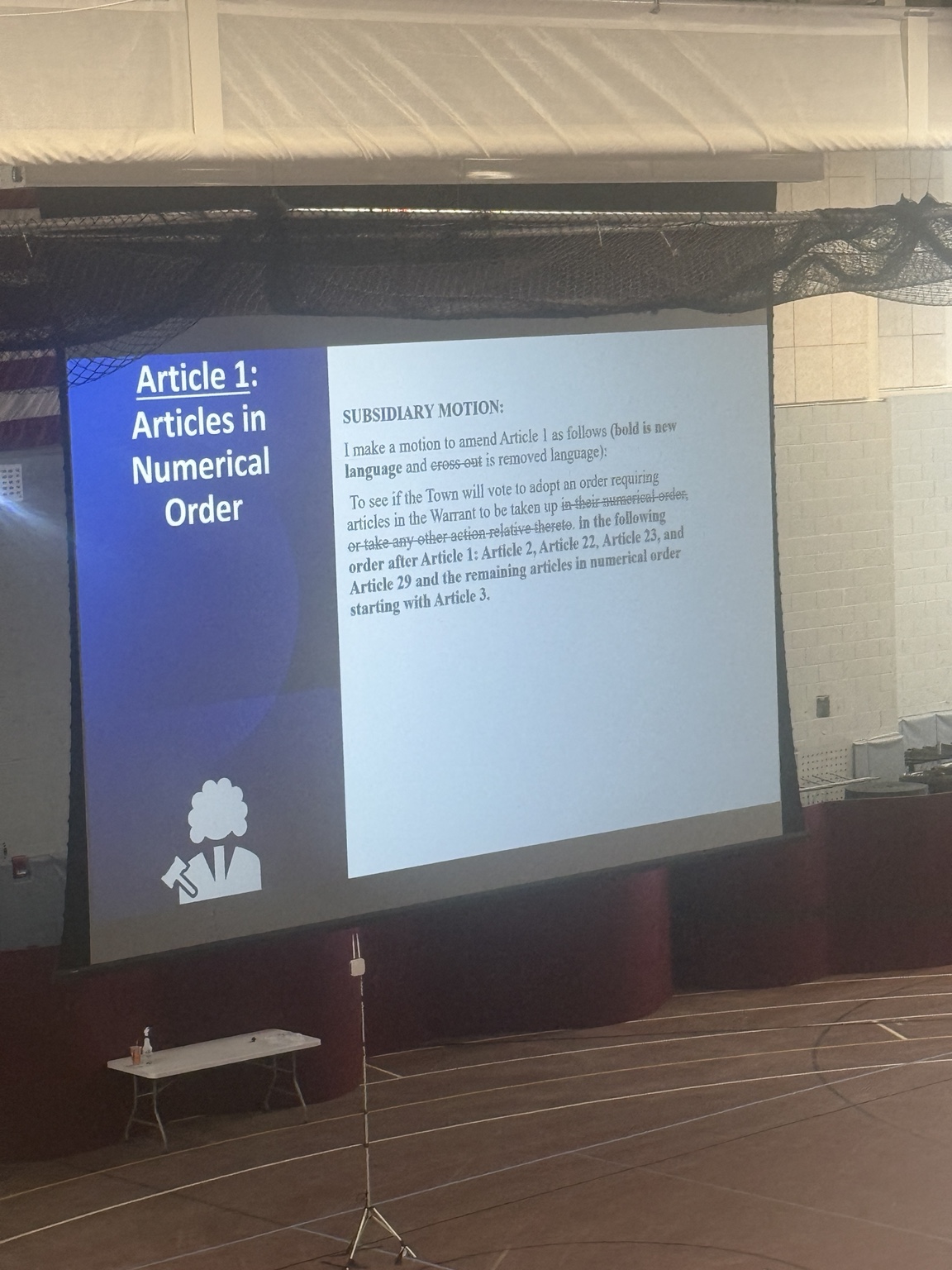
Article 1, normally a routine procedural vote requiring voters to take the warrant in numerical order, drew an early subsidiary motion to reorder the night. Matthew Hooks, a Marblehead resident speaking for the citizen group For Marblehead, moved to amend Article 1 so that after the opening procedural votes the assembly takes Article 2, then jumps to Article 22, Article 23 and Article 29 — the available-funds tax-rate reduction, the FY27 operating budget and the tiered Proposition 2½ override — before returning to Article 3 and proceeding in numerical order from there.The For Marblehead subsidiary motion to Article 1, as projected at the front of the Field House. Will Dowd / The Marblehead Independent"All of the town business before us tonight is important, and we respect the full warrant," Hooks said from the lectern. "But we also have to be honest about what this particular moment represents. The budget and override questions before us tonight are some of the most consequential decisions Marblehead has faced in many years. It will shape our schools, our infrastructure, our public safety, our services, the character of our town for years to come."
Hooks pointed to the size of the room — the moderator put attendance at roughly 1,200 — as the reason to take the biggest votes first. "Tonight's turnout speaks for itself," he said. "This community wants to have this conversation, and it deserves to have it fully — with robust debate, careful deliberation and all the time it requires. While this room is full and every voice can be heard, this is exactly the kind of decision that Town Meeting exists to make. Let's give it the weight it deserves."
The motion was seconded. Article 1 is sponsored by the Select Board. The Finance Committee made no recommendation on the underlying article. Majority vote. Town Moderator Jack Attridge said voters will take up the amendment first; if it passes, the assembly will then vote on the amended main motion.
7:14 p.m.
1,200 voters turn out as Attridge opens 377th annual Town Meeting
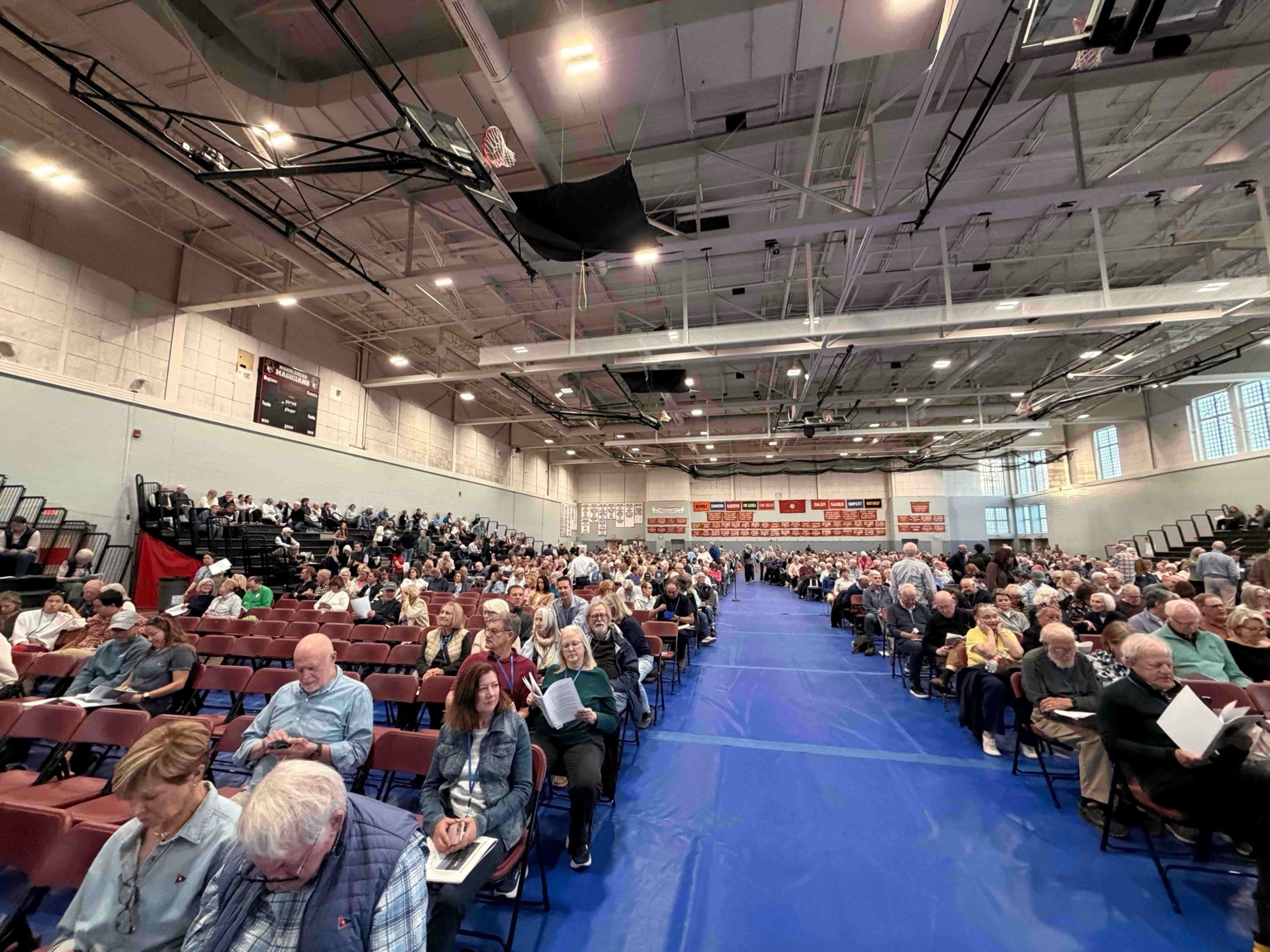
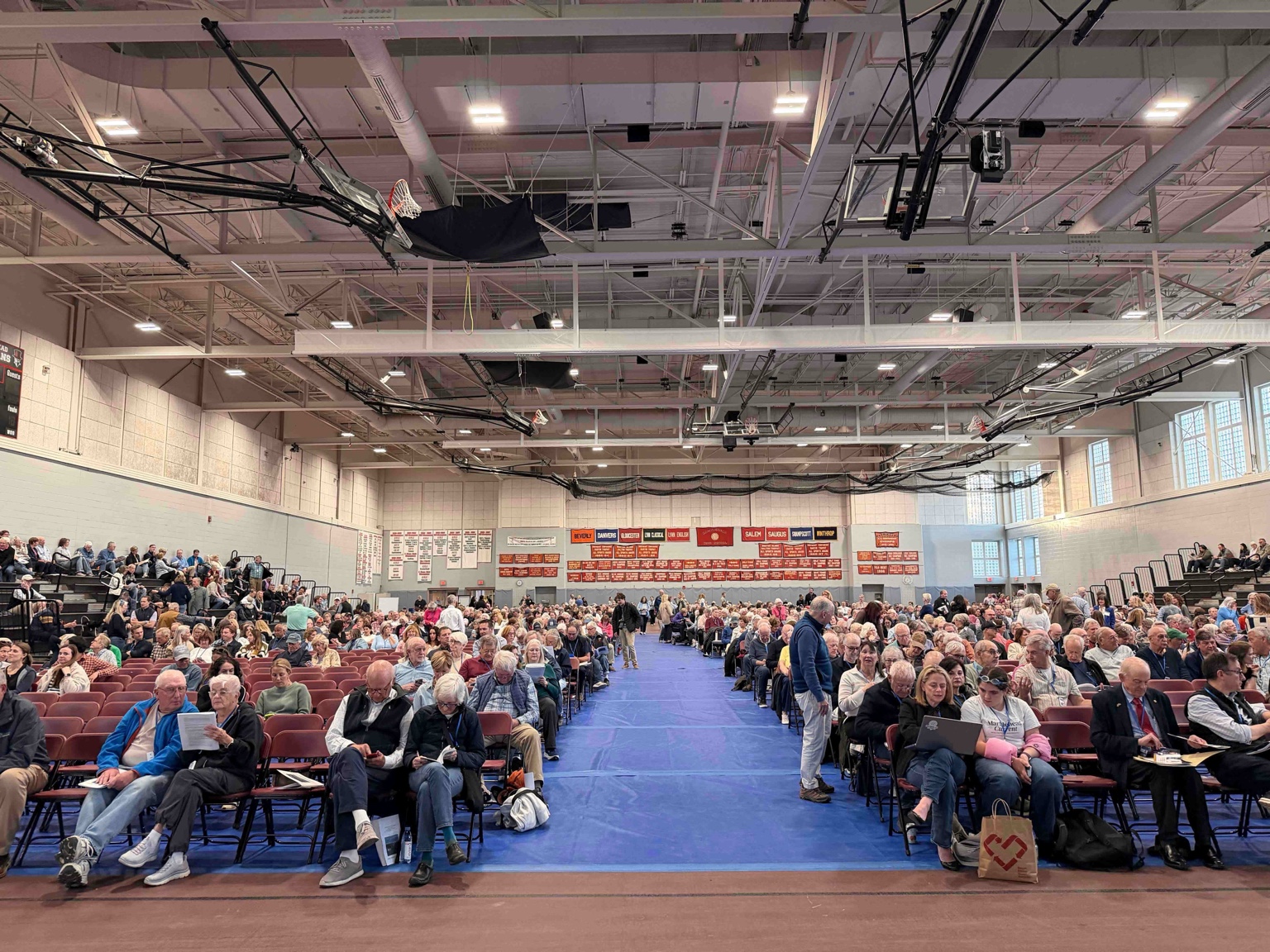
Town Moderator Jack Attridge opened the 377th annual Marblehead Town Meeting to a crowd he said totaled roughly 1,200 voters — well past the 300-person quorum and well past the nights he remembered working the phones to fill the room. "Wow. Thank you," Attridge said. "I can remember getting on the phone to try to get people to show up. So this is fantastic."
Attridge laid out the ground rules. Individual speakers after a presentation get a strict two-minute limit at the aisle microphones, with all comments routed through the moderator and no back-and-forth between voters. Initial presentations from town officials are allotted 10 minutes. Speakers must state their name and address. Subsidiary motions to a main motion may be required in writing and submitted to the lectern.
The warrant carries 40 articles, Attridge said, with 12 main motions sponsors plan to move for indefinite postponement. Those postponements and routine business votes will be taken by show of hands. This is the third year of electronic voting. Attridge said voting windows ran 30 seconds on quieter nights last year and three minutes when the room was full, and asked voters to test their clickers on a non-binding calibration question: Will Marblehead beat Swampscott in the Thanksgiving Day football game? Devices are being tested now.
Past practice, Attridge said, is to check in with the assembly any time the meeting runs past 10 p.m. He reminded voters of the bylaw requiring speakers to confine remarks to the question before the meeting, avoid personalities and sit down when finished. "The assembly deserves order," he said, "and I'll not tolerate catcalling or disruptions to the meeting."
7:10 p.m.
Pledge, land acknowledgment and a "No Place for Hate" reminder
Before the procedural votes, the meeting opened with the customary observances. Ronnie Knight, chaplain at Marblehead's Veterans of Foreign Wars Lyman Rollins Post 2005, led the Pledge of Allegiance. Diane Gora delivered the town's land acknowledgment, recognizing the Naumkeag people of the Massachusetts and Pawtucket tribes as the original stewards of the land Marblehead now occupies and pledging "to include their history in the history of our town."
Senior Deacon John E. "Joe" Whipple followed with a statement on behalf of the Select Board's task force against discrimination. Whipple noted that 1649, the year the General Court of the colony of Massachusetts Bay established Marblehead as a town, preceded the Continental Congress's 1776 Declaration of Independence by 127 years — a 250th anniversary that, he said, "we can rightly celebrate this year, and especially two months from today." The task force was created in 1989 in response to anti-Semitic vandalism in town. Marblehead is recognized as a "No Place for Hate" community. Whipple invited residents to an evening with David Shribman, a Pulitzer Prize-winning journalist originally from the North Shore, on Wednesday at 7 p.m. in the high school auditorium. Shribman's topic: portrayals of anti-Semitism. The event is co-sponsored with the public schools, the Police Department and the Marblehead Ministerial Association.
7:03 p.m.
Gavel-in: 2026 Annual Town Meeting is now in session
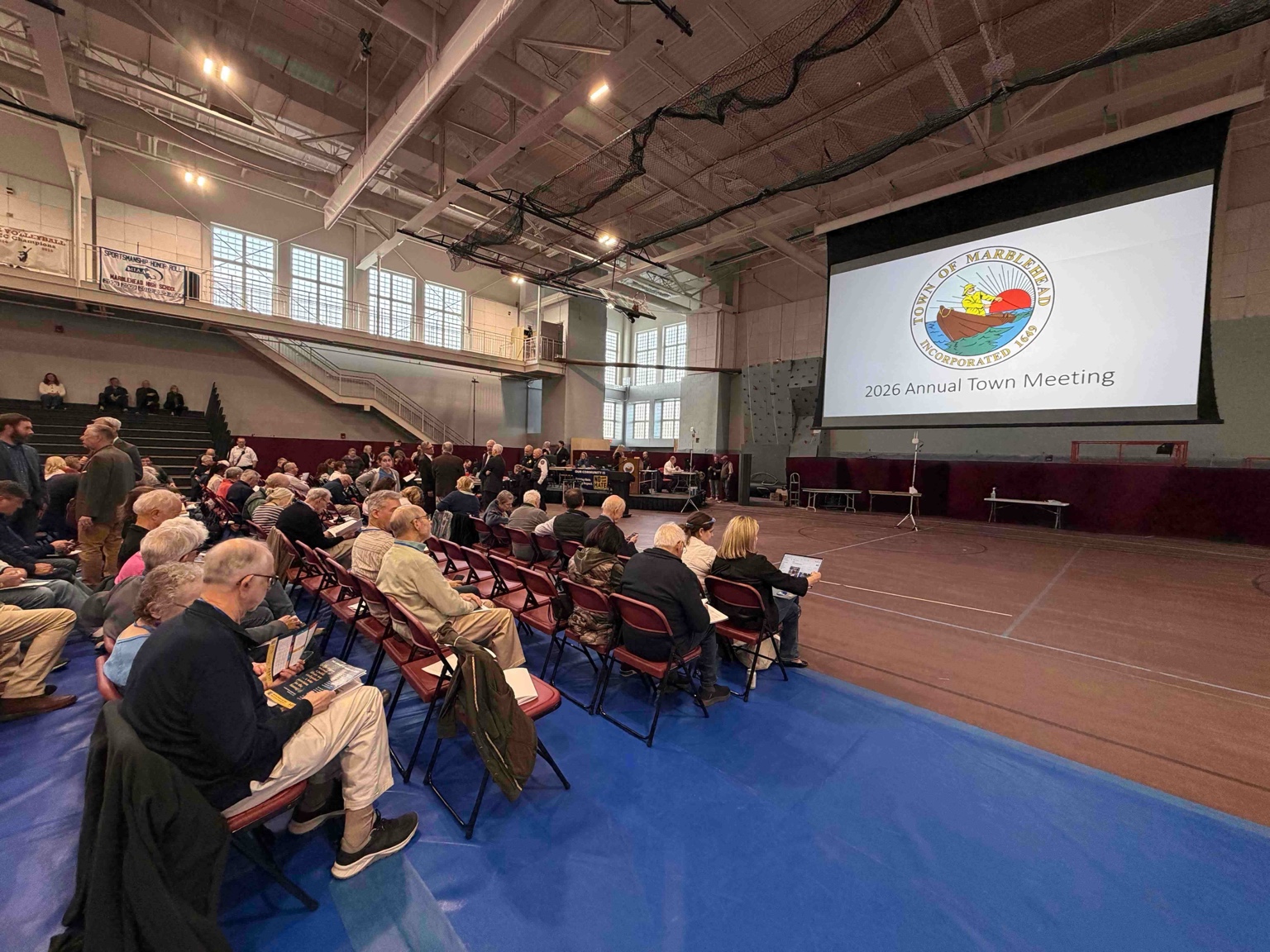
The 2026 Annual Town Meeting is gaveled into session. The Town of Marblehead seal — "Incorporated 1649" — glows from the projection screen at the front of the floor as voters take their seats. Forty articles ahead.
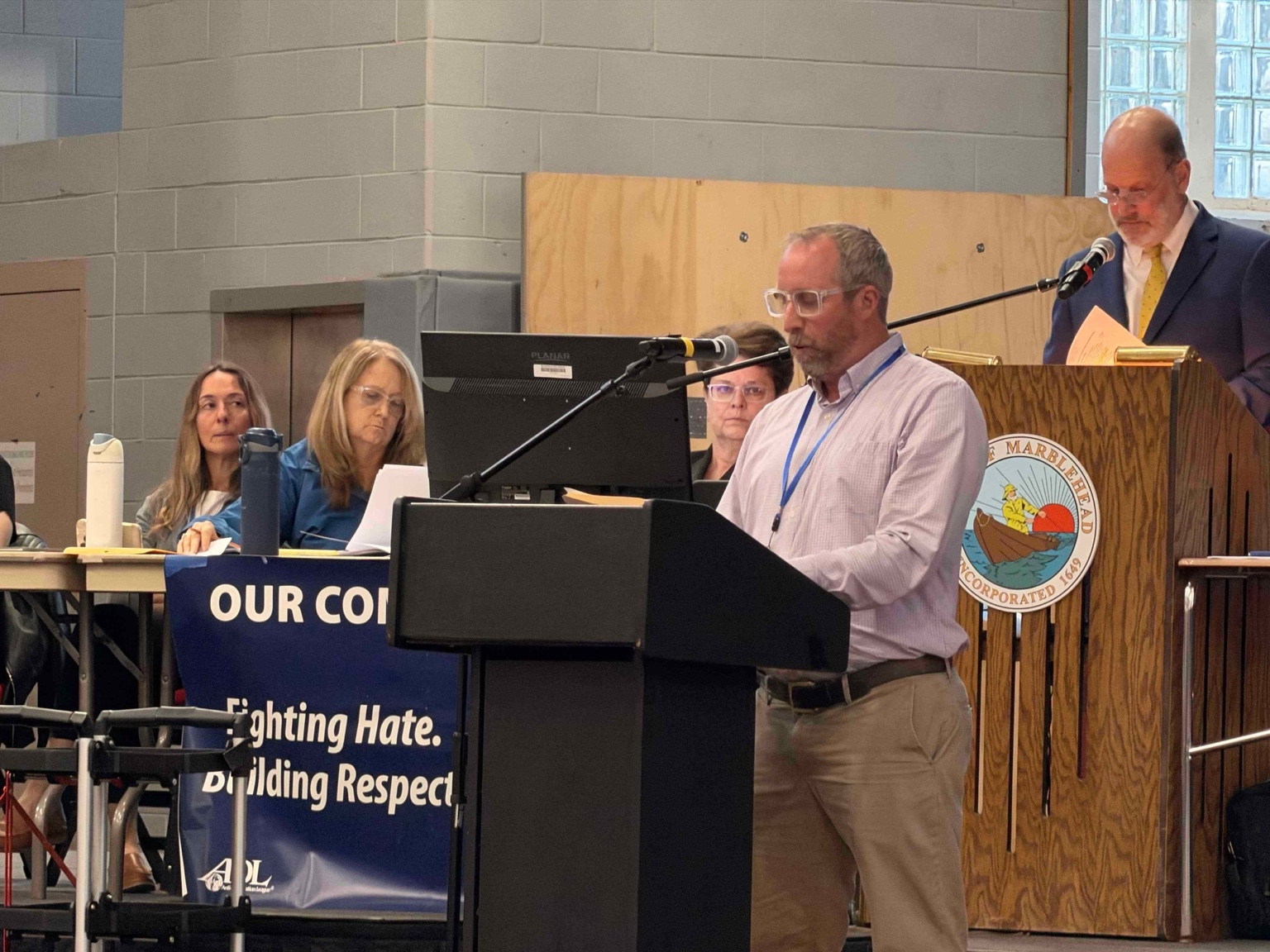
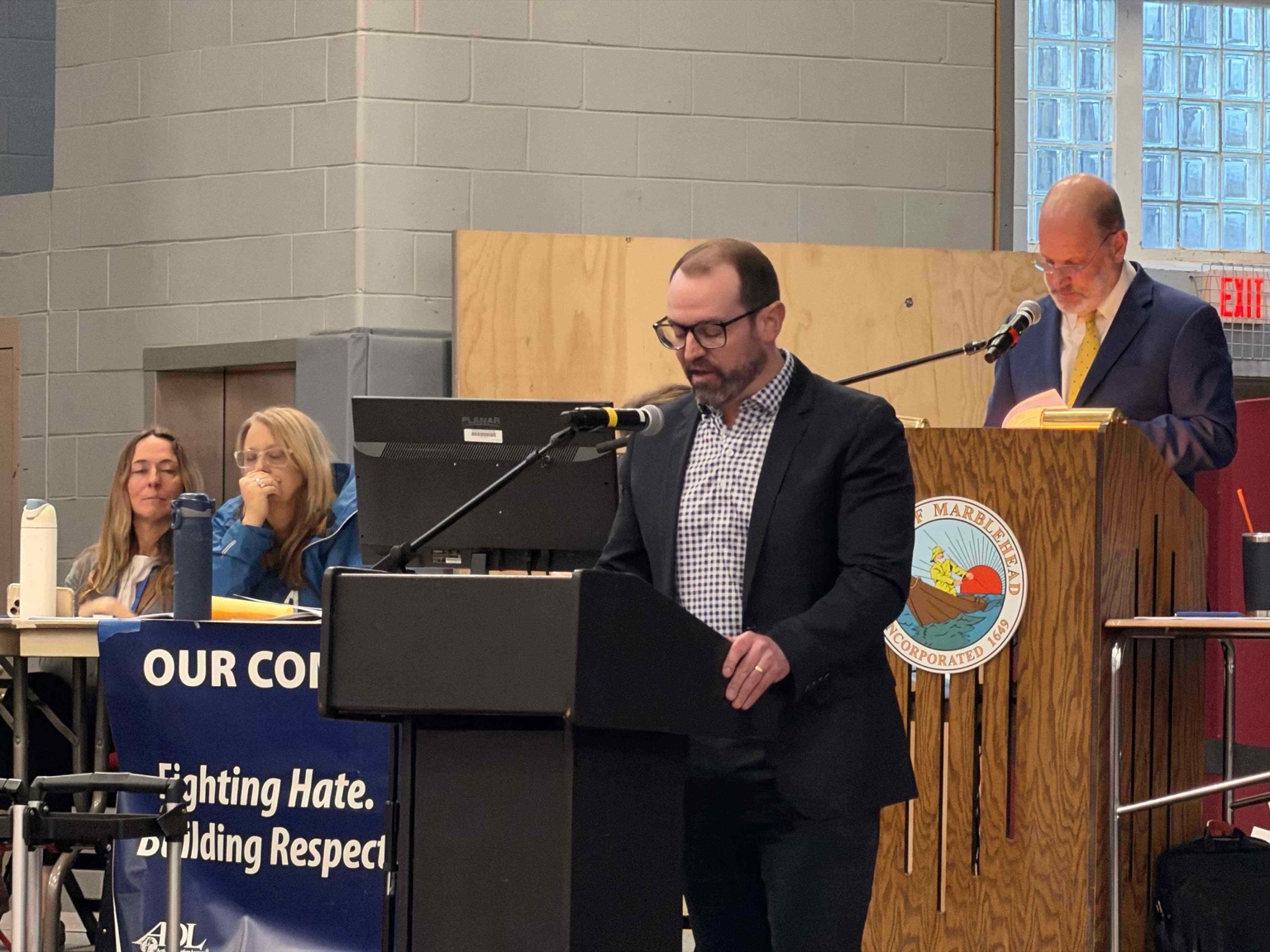
Katie Ring / The Marblehead IndependentKatie Ring / The Marblehead IndependentKatie Ring / The Marblehead IndependentKatie Ring / The Marblehead Independent
7:00 p.m.
Town Meeting not yet in session
The 7 p.m. start time has passed and Town Meeting is not yet in session. Voters are still settling into their seats. We'll post the gavel as soon as it falls.
6:57 p.m.
Outside the high school, an Article 40 sponsor hands out copies of the Constitution
Earlier this evening, outside the Marblehead High School, Lynn Nadeau was passing out pocket-sized 250th-anniversary copies of the U.S. Constitution to voters arriving for Town Meeting. Nadeau is one of the citizen petitioners behind Article 40, a non-binding resolution affirming the town's commitment to the Declaration of Independence and the Constitution. The article, sponsored by Kate Borten, Lynn Nadeau and others, comes near the end of the warrant.Lynn Nadeau, a citizen petitioner behind Article 40, hands out 250th-anniversary copies of the U.S. Constitution outside Marblehead High School before the start of the 2026 Annual Town Meeting. Will Dowd / The Marblehead Independent
6:51 p.m.
In the press balcony, working alongside Essex News Media and MHTV
Filing tonight from the press balcony with Sophia Harris, editorial director at Essex News Media, the regional newsroom whose papers include the Daily Item, the Salem News and the Gloucester Daily Times. Behind us, Jon Caswell, programming manager of Marblehead Community Access and Media, is setting up the camera that will carry tonight's livestream to viewers at home. Two laptops, one warrant, plenty of kettle corn.Sophia Harris, editorial director at Essex News Media, and Will Dowd of The Marblehead Independent set up in the press balcony ahead of gavel-in. In the background, Jon Caswell, programming manager of Marblehead Community Access and Media, runs the livestream camera. Will Dowd / The Marblehead Independent
6:37 p.m.
Good evening, Marblehead
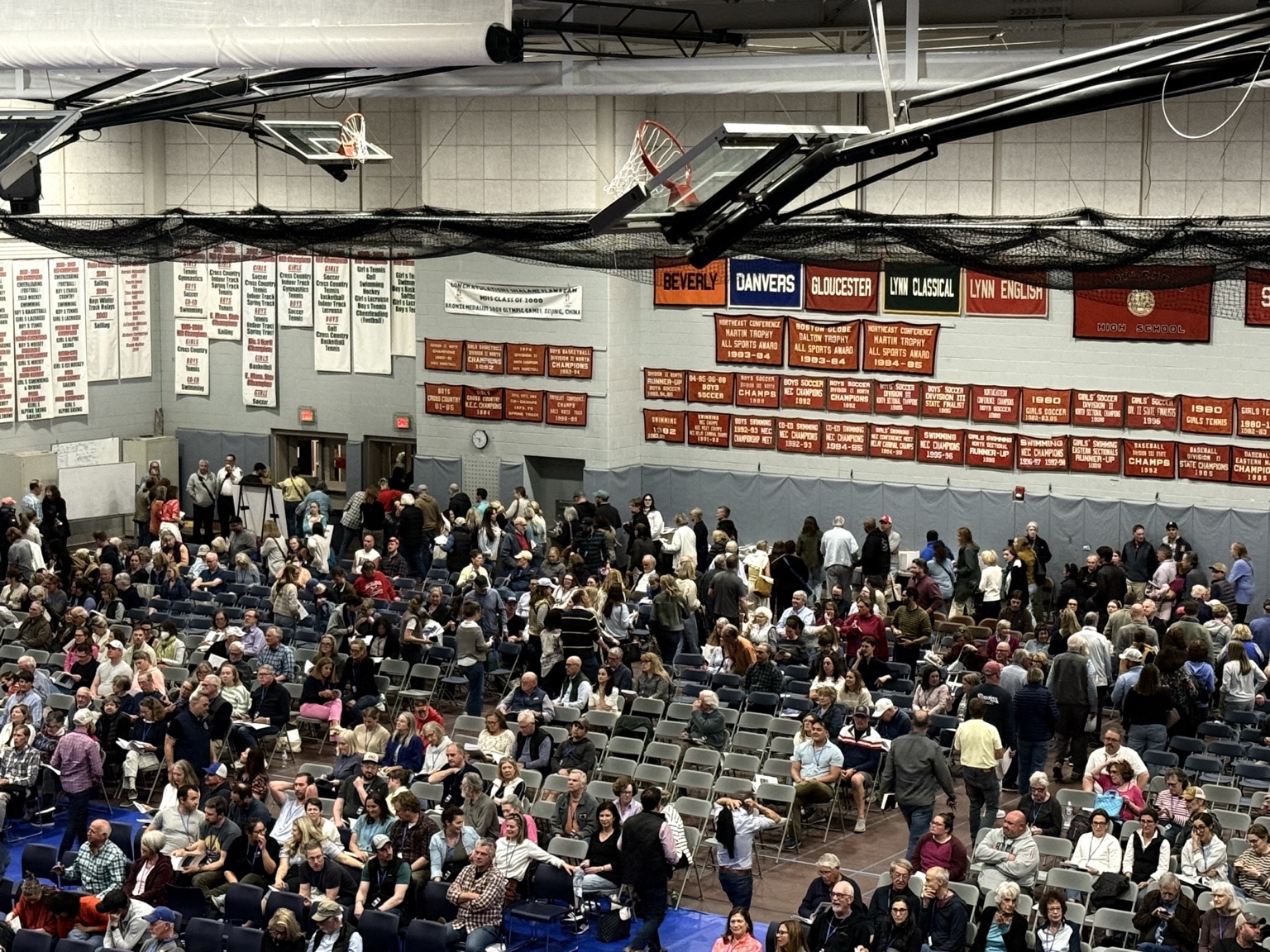
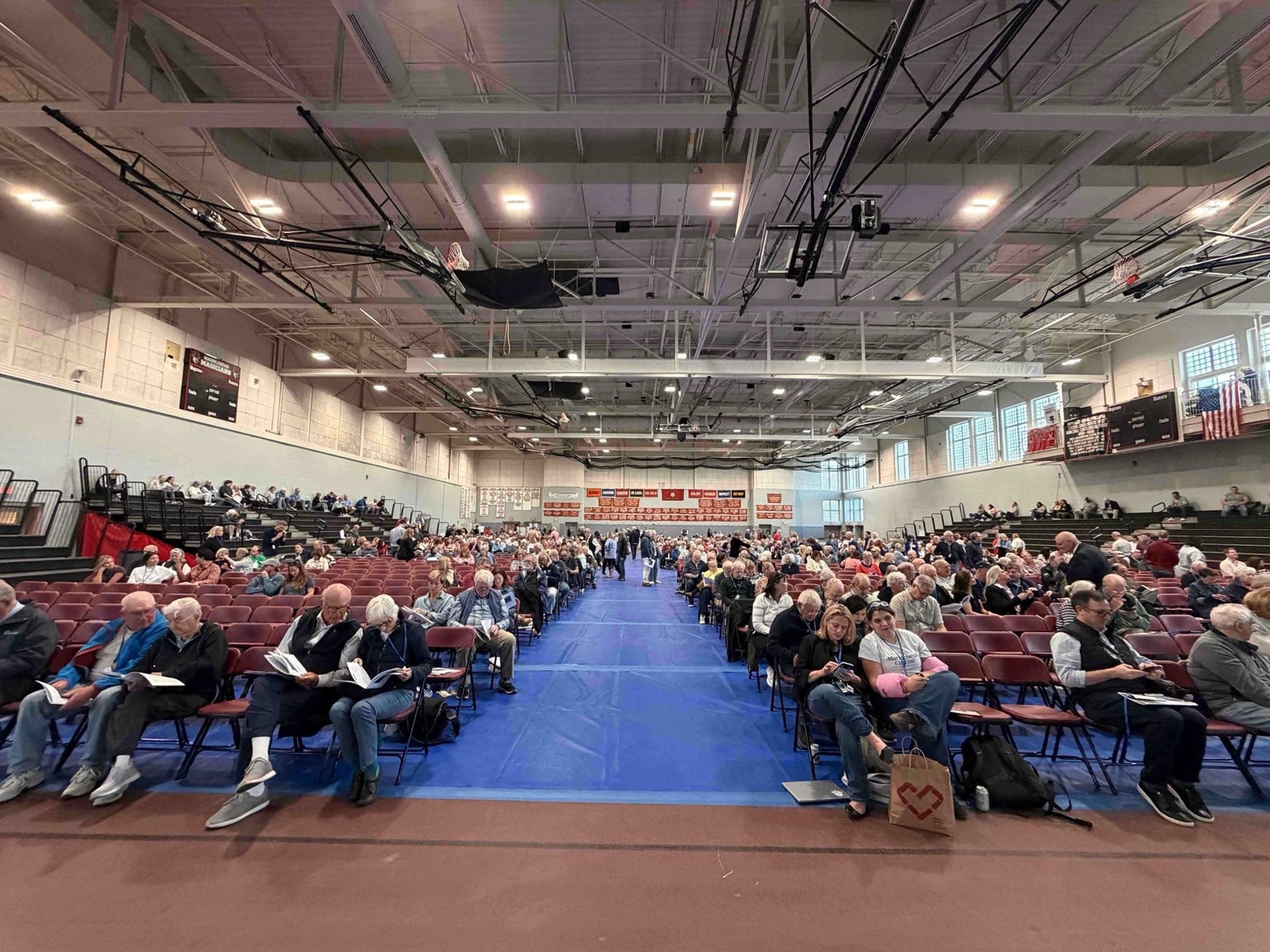
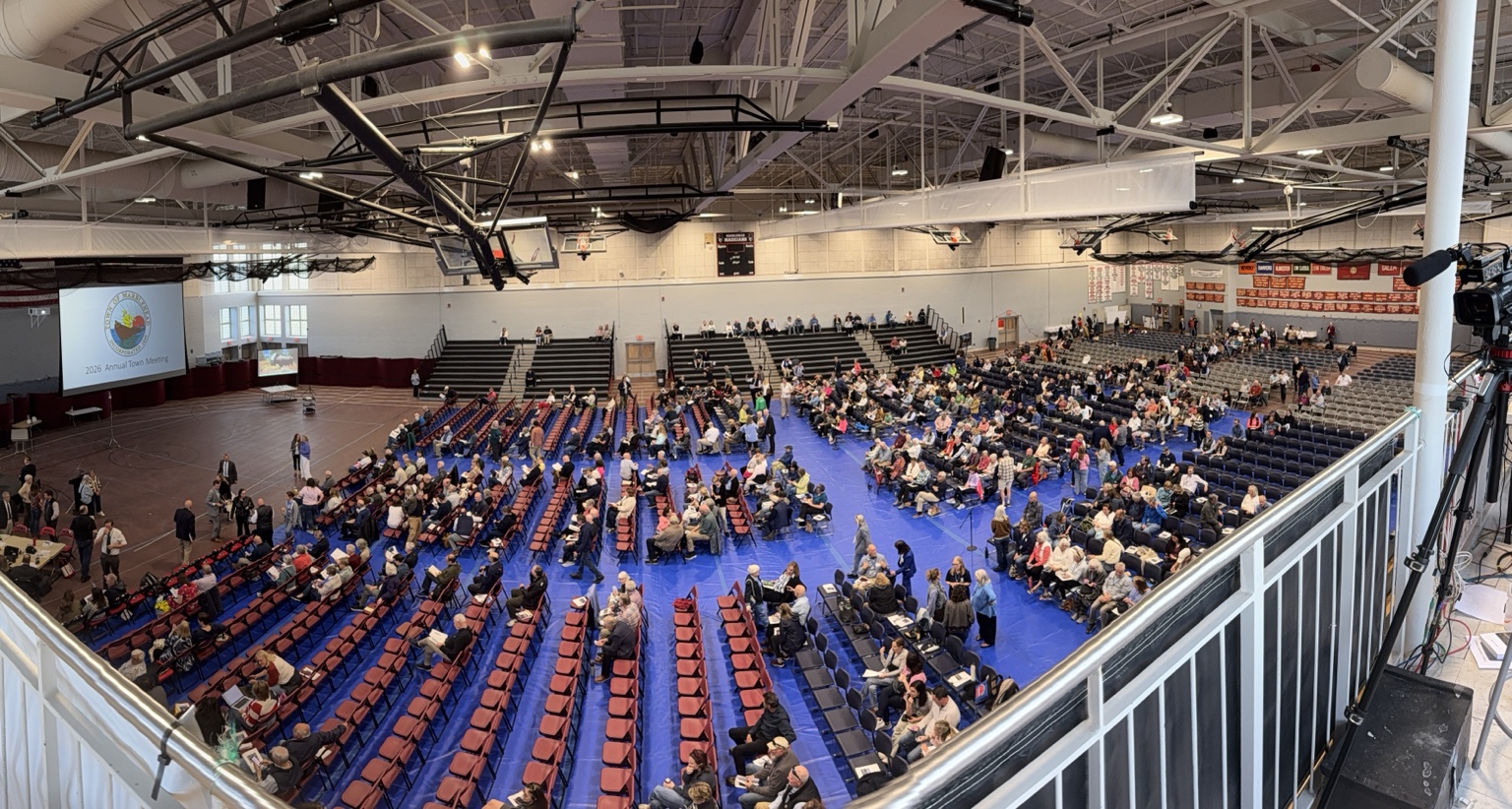
We're up in the press balcony at the Marblehead High School Field House — left side as you face the main stage — for the 2026 Annual Town Meeting. The room is filling in steadily, with neighbors drifting in and finding seats among rows of red folding chairs.The Field House fills ahead of gavel-in. Will Dowd / The Marblehead IndependentIf you can't be in the room, Marblehead Community Access and Media is streaming the proceedings. The YouTube stream goes live at 6:45 p.m. — watch on MHTV. You can also tune in on Comcast 8 (HD 1073) or Verizon 28 (HD 2128).
Stay with us here for live updates from gavel to adjournment. Forty articles tonight, including the 3A multifamily overlay, the FY27 operating budget and the tiered Proposition 2½ override package. Quorum is 300. Gavel falls at 7.
On a phone, rotate to landscape for the best reading experience.
40 of 40 shown
Border key: High stakes Notable Routine
Article
Title / key detail
Category
Vote required
Recommendation
Town Meeting vote
Tiered override explainer
Article 23 sets the no-override baseline at $109.8 million (general fund).
Three tiered override ballot questions will ask voters for $9 million, $12 million or $15 million in new revenue, split 62/38 between schools and town under an MOU.
Article 29 is now the primary town-side override article: it is expected to carry the roughly $4.3M FY27 contingent appropriation, representing year one of the highest tier, while also framing how the three-year, three-tier structure would work.
Article 28 remains the school supplemental article. Officials said the exact legal wording and detailed breakdown for Article 29 were still being refined with town counsel as of April 22, but the policy decision to anchor the override structure there had already been made.
A separate $2.3 million trash override would fund curbside collection through the tax levy.
If both overrides fail, Articles 28 and 29 are void — and the $2.19M
curbside collection line item in Article 23 converts to a
roughly $262/household fee administered by the Board of Health.
Source: 2026 Annual Town Meeting Warrant · Select Board-approved FY2027 budget · April 6 FinCom warrant hearing · April 8 Select Board override vote · April 9 School Committee override vote